Digital Wedding Invitation Card
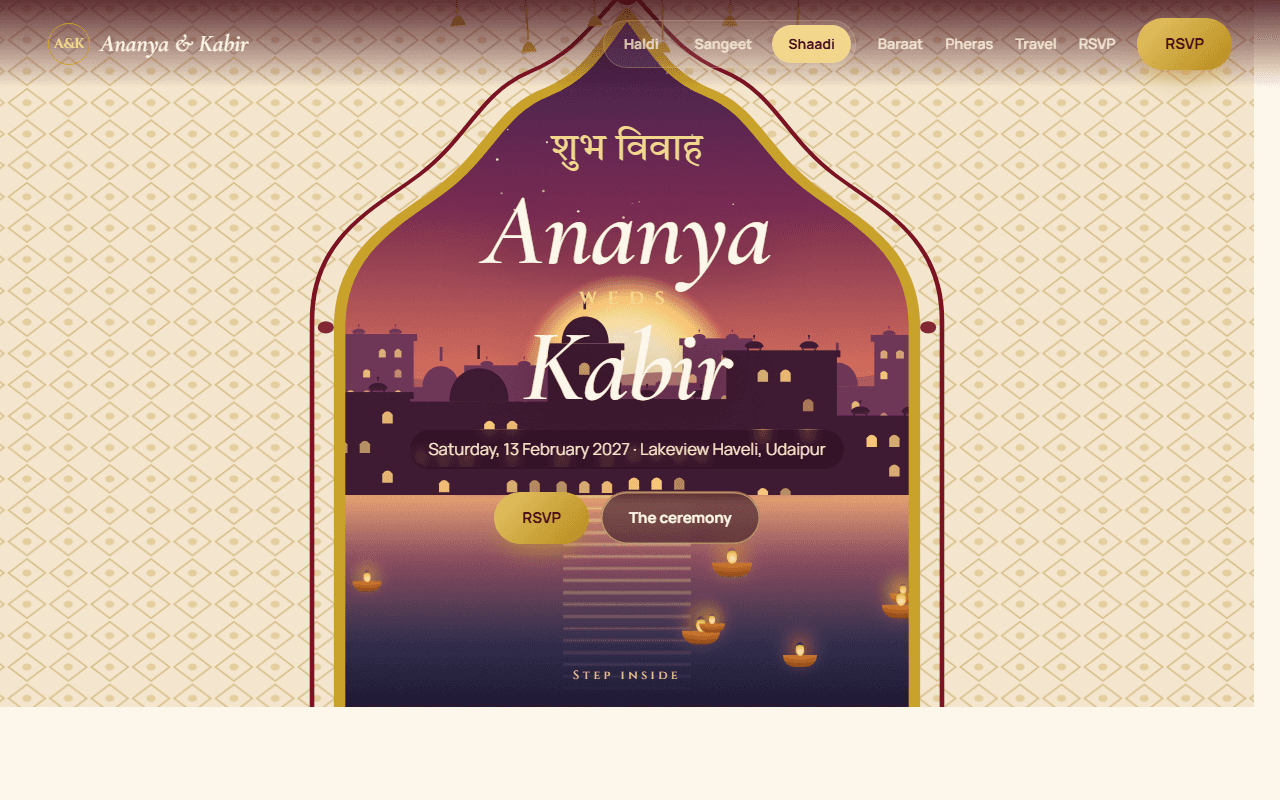
A luxury digital wedding card: a wax seal cracks, the envelope opens and the card slides out, a laser-cut paper scene tilts in 3D, gatefold doors open on the date, plus flip cards, a postcard, an RSVP and personal guest links.

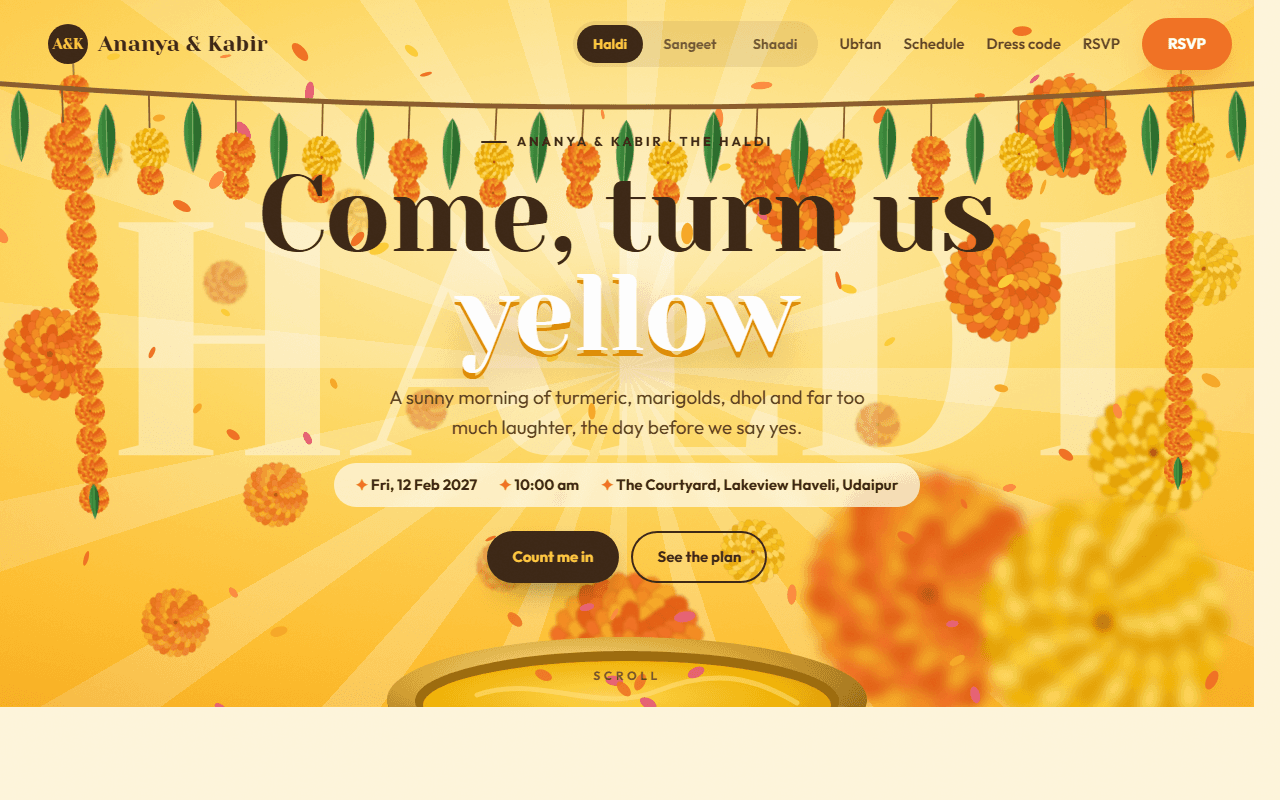
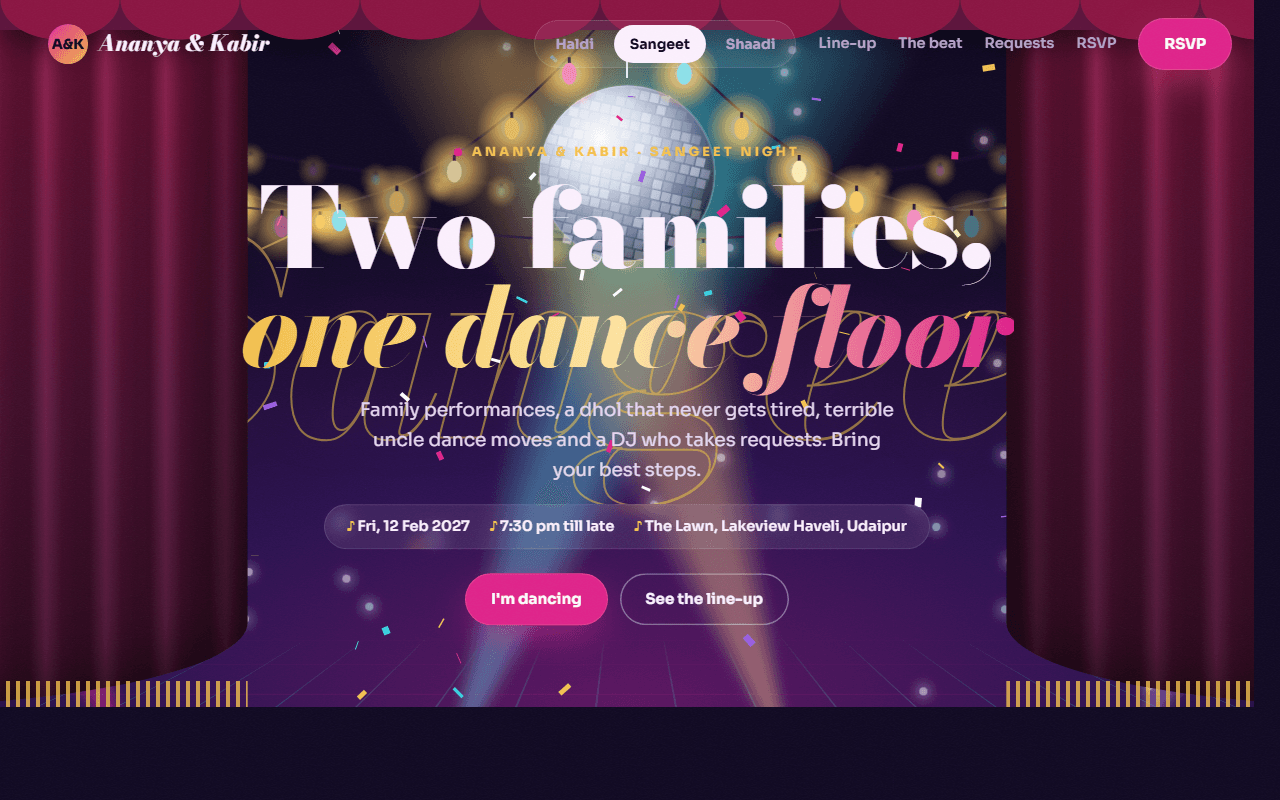
Example of the website this prompt builds. Your result will use your own name, text and images. Open the live version, built from these exact prompts.
- Tech stack
- HTML, CSS, GSAP ScrollTrigger & Lenis
- Colour palette
#0a2b27#fbf4e4#c9a227#b3164f
- What it builds
- Navbar with event links
- Envelope that opens
- Laser-cut paper hero
- Invitation wording
- Gatefold save-the-date
- Event cards
- Flip-clock countdown
- Venue postcard
- RSVP card & personal links
- Footer
Build the whole website step by step
16 prompts, in order. Paste step 1 into Claude, ChatGPT, Cursor or any AI coding tool, wait until that part works, then paste the next one in the same chat. Each step builds one piece: the project setup, every section of the home page, the extra pages a real Wedding & Events website needs, and finally polish, SEO and launch. Type your business name and colours in "Make it yours" first and every prompt updates for you. Tick off steps as you go; your progress is saved in this browser.
Make it yours
Fill in your own details and every prompt below updates, so you don't have to edit them by hand. All fields are optional.
Setup1 step
Set up the project and design systemUp next
A clean HTML file with CSS variables, fonts and base styles, ready for sections.

Copy step 1, paste it into your AI tool in the same chat, and you will get a result like the preview.
Show the prompt for step 1
Build a digital Indian wedding invitation card website for a couple called "Ananya & Kabir", getting married at "Lakeview Haveli", Udaipur, on Saturday 13 February 2027 (saat phere at 8:14 pm), with a haldi and a sangeet the day before.

We will build this step by step. In this first step, ONLY set up the project and the design system — do not build any page sections yet.

Tech stack: one HTML file with inline CSS and JavaScript. Load GSAP 3.12.5 and ScrollTrigger from cdnjs and Lenis 1.1.13 from jsDelivr, and connect them (lenis.on("scroll", ScrollTrigger.update); gsap.ticker.add(t => lenis.raf(t * 1000)); gsap.ticker.lagSmoothing(0)). Use gsap.matchMedia so phones get lighter versions.

Visual style: a luxury printed card lying on velvet. Deep emerald velvet background (#0a2b27) with a faint gold damask pattern and slowly rising gold dust drawn on a canvas, ivory paper (#fbf4e4) with peach and blush paper layers, gold foil (#c9a227) made from a multi-stop gold gradient clipped to text whose shine follows the mouse, and a rani pink accent (#b3164f). Fonts: Pinyon Script for the names, Cinzel for small capitals, Playfair Display for the wording, Jost for buttons and forms, and Tiro Devanagari Hindi for "शुभ विवाह".

Do the following:
1. Create one index.html file with a <style> block and a <script> block at the end.
2. Define the colour palette (#0a2b27, #fbf4e4, #c9a227, #b3164f) as CSS custom properties on :root with clear names, plus spacing and radius variables.
3. Load at most two Google Fonts and set the base typography scale (h1–h4, body, small).
4. Add base styles: box-sizing reset, a .container class, .btn variants (primary, secondary), .card, and a .section spacing class.
5. Add empty, clearly commented placeholders for these sections in order: Navbar with event links, Envelope that opens, Laser-cut paper hero, Invitation wording, Gatefold save-the-date, Event cards, Flip-clock countdown, Venue postcard, RSVP card & personal links, Footer.

Explain briefly what each file does. Keep the code clean and commented.
Home page11 steps
Navbar with event links
A round "A&K" monogram, a pill with links to Invite, Haldi, Sangeet and Shaadi pages, and a gold "RSVP" button.

Copy step 2, paste it into your AI tool in the same chat, and you will get a result like the preview, in your own colours and content.
Show the prompt for step 2
Project recap: we are building Ananya & Kabir — A luxury digital wedding card: a wax seal cracks, the envelope opens and the card slides out, a laser-cut paper scene tilts in 3D, gatefold doors open on the date, plus flip cards, a postcard, an RSVP and personal guest links. Stack: HTML, CSS, GSAP ScrollTrigger & Lenis. Keep using the design system, colours, fonts and components we already created; do not rewrite earlier sections.

Now build ONLY section 1 of 10: Navbar with event links.

Requirements:
a round "A&K" monogram, a pill with links to Invite, Haldi, Sangeet and Shaadi pages, and a gold "RSVP" button.

Fill in the "Navbar with event links" placeholder in index.html. Put its CSS next to the other section styles and any JavaScript in the existing <script> block.

Rules:
- Use only the existing design tokens and UI components; add new tokens only if truly needed and tell me.
- Mobile-first and responsive at 375px, 768px and 1200px+.
- Accessible: semantic elements, correct heading level (only the hero uses h1), alt text, keyboard focus styles, labels on any form fields.
- Realistic sample content for Ananya & Kabir (no lorem ipsum).
- Show me the complete code for every file you create or change.
Envelope that opens
A cream envelope (back, pocket drawn in SVG, a flap with a gold edge) with a red wax seal "A&K" built from two…

Copy step 3, paste it into your AI tool in the same chat, and you will get a result like the preview, in your own colours and content.
Show the prompt for step 3
Project recap: we are building Ananya & Kabir — A luxury digital wedding card: a wax seal cracks, the envelope opens and the card slides out, a laser-cut paper scene tilts in 3D, gatefold doors open on the date, plus flip cards, a postcard, an RSVP and personal guest links. Stack: HTML, CSS, GSAP ScrollTrigger & Lenis. Keep using the design system, colours, fonts and components we already created; do not rewrite earlier sections.

Now build ONLY section 2 of 10: Envelope that opens.

Requirements:
a cream envelope (back, pocket drawn in SVG, a flap with a gold edge) with a red wax seal "A&K" built from two clipped halves. Above it, "An invitation for" and the guest's name read from ?guest=Name in the URL, and below it "Tap the seal or scroll".

Fill in the "Envelope that opens" placeholder in index.html. Put its CSS next to the other section styles and any JavaScript in the existing <script> block.

Rules:
- Use only the existing design tokens and UI components; add new tokens only if truly needed and tell me.
- Mobile-first and responsive at 375px, 768px and 1200px+.
- Accessible: semantic elements, correct heading level (only the hero uses h1), alt text, keyboard focus styles, labels on any form fields.
- Realistic sample content for Ananya & Kabir (no lorem ipsum).
- Show me the complete code for every file you create or change.
Laser-cut paper hero
Five layered SVG paper cut-outs generated in JavaScript (a tall arch panel with a gold outline, a scalloped row of…

Copy step 4, paste it into your AI tool in the same chat, and you will get a result like the preview, in your own colours and content.
Show the prompt for step 4
Project recap: we are building Ananya & Kabir — A luxury digital wedding card: a wax seal cracks, the envelope opens and the card slides out, a laser-cut paper scene tilts in 3D, gatefold doors open on the date, plus flip cards, a postcard, an RSVP and personal guest links. Stack: HTML, CSS, GSAP ScrollTrigger & Lenis. Keep using the design system, colours, fonts and components we already created; do not rewrite earlier sections.

Now build ONLY section 3 of 10: Laser-cut paper hero.

Requirements:
five layered SVG paper cut-outs generated in JavaScript (a tall arch panel with a gold outline, a scalloped row of arched windows with gold studs, a smaller arch row, a jaali lattice band and a floral band), each with a soft drop shadow, and the couple's names in gold foil inside the arch with the date and venue.

Fill in the "Laser-cut paper hero" placeholder in index.html. Put its CSS next to the other section styles and any JavaScript in the existing <script> block.

Rules:
- Use only the existing design tokens and UI components; add new tokens only if truly needed and tell me.
- Mobile-first and responsive at 375px, 768px and 1200px+.
- Accessible: semantic elements, correct heading level (only the hero uses h1), alt text, keyboard focus styles, labels on any form fields.
- Realistic sample content for Ananya & Kabir (no lorem ipsum).
- Show me the complete code for every file you create or change.
Invitation wording
An ivory letter with double gold borders, gold corner ornaments and a small kalash, with the grandparents' blessings,…

Copy step 5, paste it into your AI tool in the same chat, and you will get a result like the preview, in your own colours and content.
Show the prompt for step 5
Project recap: we are building Ananya & Kabir — A luxury digital wedding card: a wax seal cracks, the envelope opens and the card slides out, a laser-cut paper scene tilts in 3D, gatefold doors open on the date, plus flip cards, a postcard, an RSVP and personal guest links. Stack: HTML, CSS, GSAP ScrollTrigger & Lenis. Keep using the design system, colours, fonts and components we already created; do not rewrite earlier sections.

Now build ONLY section 4 of 10: Invitation wording.

Requirements:
an ivory letter with double gold borders, gold corner ornaments and a small kalash, with the grandparents' blessings, both families' names, "request the pleasure of your company", the couple's names in script and the date and time.

Fill in the "Invitation wording" placeholder in index.html. Put its CSS next to the other section styles and any JavaScript in the existing <script> block.

Rules:
- Use only the existing design tokens and UI components; add new tokens only if truly needed and tell me.
- Mobile-first and responsive at 375px, 768px and 1200px+.
- Accessible: semantic elements, correct heading level (only the hero uses h1), alt text, keyboard focus styles, labels on any form fields.
- Realistic sample content for Ananya & Kabir (no lorem ipsum).
- Show me the complete code for every file you create or change.
Gatefold save-the-date
A card with two doors decorated with half-mandala gold dots and paisleys; behind the doors "13 | 02 | 27", "the…

Copy step 6, paste it into your AI tool in the same chat, and you will get a result like the preview, in your own colours and content.
Show the prompt for step 6
Project recap: we are building Ananya & Kabir — A luxury digital wedding card: a wax seal cracks, the envelope opens and the card slides out, a laser-cut paper scene tilts in 3D, gatefold doors open on the date, plus flip cards, a postcard, an RSVP and personal guest links. Stack: HTML, CSS, GSAP ScrollTrigger & Lenis. Keep using the design system, colours, fonts and components we already created; do not rewrite earlier sections.

Now build ONLY section 5 of 10: Gatefold save-the-date.

Requirements:
a card with two doors decorated with half-mandala gold dots and paisleys; behind the doors "13 | 02 | 27", "the auspicious muhurat" and the ceremony times; a large line mandala rotates behind the card.

Fill in the "Gatefold save-the-date" placeholder in index.html. Put its CSS next to the other section styles and any JavaScript in the existing <script> block.

Rules:
- Use only the existing design tokens and UI components; add new tokens only if truly needed and tell me.
- Mobile-first and responsive at 375px, 768px and 1200px+.
- Accessible: semantic elements, correct heading level (only the hero uses h1), alt text, keyboard focus styles, labels on any form fields.
- Realistic sample content for Ananya & Kabir (no lorem ipsum).
- Show me the complete code for every file you create or change.
Event cards
Three tall cards (Haldi in yellow and orange, Sangeet in pink and purple, Shaadi in gold and maroon) with simple SVG…

Copy step 7, paste it into your AI tool in the same chat, and you will get a result like the preview, in your own colours and content.
Show the prompt for step 7
Project recap: we are building Ananya & Kabir — A luxury digital wedding card: a wax seal cracks, the envelope opens and the card slides out, a laser-cut paper scene tilts in 3D, gatefold doors open on the date, plus flip cards, a postcard, an RSVP and personal guest links. Stack: HTML, CSS, GSAP ScrollTrigger & Lenis. Keep using the design system, colours, fonts and components we already created; do not rewrite earlier sections.

Now build ONLY section 6 of 10: Event cards.

Requirements:
three tall cards (Haldi in yellow and orange, Sangeet in pink and purple, Shaadi in gold and maroon) with simple SVG art; clicking or pressing Enter flips a card to show the time, place, dress code and a link to that event's page.

Fill in the "Event cards" placeholder in index.html. Put its CSS next to the other section styles and any JavaScript in the existing <script> block.

Rules:
- Use only the existing design tokens and UI components; add new tokens only if truly needed and tell me.
- Mobile-first and responsive at 375px, 768px and 1200px+.
- Accessible: semantic elements, correct heading level (only the hero uses h1), alt text, keyboard focus styles, labels on any form fields.
- Realistic sample content for Ananya & Kabir (no lorem ipsum).
- Show me the complete code for every file you create or change.
Flip-clock countdown
Days, hours, minutes and seconds to the muhurat in split ivory tiles that flip when the number changes.

Copy step 8, paste it into your AI tool in the same chat, and you will get a result like the preview, in your own colours and content.
Show the prompt for step 8
Project recap: we are building Ananya & Kabir — A luxury digital wedding card: a wax seal cracks, the envelope opens and the card slides out, a laser-cut paper scene tilts in 3D, gatefold doors open on the date, plus flip cards, a postcard, an RSVP and personal guest links. Stack: HTML, CSS, GSAP ScrollTrigger & Lenis. Keep using the design system, colours, fonts and components we already created; do not rewrite earlier sections.

Now build ONLY section 7 of 10: Flip-clock countdown.

Requirements:
days, hours, minutes and seconds to the muhurat in split ivory tiles that flip when the number changes.

Fill in the "Flip-clock countdown" placeholder in index.html. Put its CSS next to the other section styles and any JavaScript in the existing <script> block.

Rules:
- Use only the existing design tokens and UI components; add new tokens only if truly needed and tell me.
- Mobile-first and responsive at 375px, 768px and 1200px+.
- Accessible: semantic elements, correct heading level (only the hero uses h1), alt text, keyboard focus styles, labels on any form fields.
- Realistic sample content for Ananya & Kabir (no lorem ipsum).
- Show me the complete code for every file you create or change.
Venue postcard
An illustrated lake and palace on the left; on the right a perforated stamp, a round postmark, the venue name,…

Copy step 9, paste it into your AI tool in the same chat, and you will get a result like the preview, in your own colours and content.
Show the prompt for step 9
Project recap: we are building Ananya & Kabir — A luxury digital wedding card: a wax seal cracks, the envelope opens and the card slides out, a laser-cut paper scene tilts in 3D, gatefold doors open on the date, plus flip cards, a postcard, an RSVP and personal guest links. Stack: HTML, CSS, GSAP ScrollTrigger & Lenis. Keep using the design system, colours, fonts and components we already created; do not rewrite earlier sections.

Now build ONLY section 8 of 10: Venue postcard.

Requirements:
an illustrated lake and palace on the left; on the right a perforated stamp, a round postmark, the venue name, address lines, a "Directions" link and an "Add to calendar" button that downloads a real .ics file.

Fill in the "Venue postcard" placeholder in index.html. Put its CSS next to the other section styles and any JavaScript in the existing <script> block.

Rules:
- Use only the existing design tokens and UI components; add new tokens only if truly needed and tell me.
- Mobile-first and responsive at 375px, 768px and 1200px+.
- Accessible: semantic elements, correct heading level (only the hero uses h1), alt text, keyboard focus styles, labels on any form fields.
- Realistic sample content for Ananya & Kabir (no lorem ipsum).
- Show me the complete code for every file you create or change.
RSVP card & personal links
An ivory card greeting the guest by name with an accept/decline toggle, name, phone, number of guests, event…

Copy step 10, paste it into your AI tool in the same chat, and you will get a result like the preview, in your own colours and content.
Show the prompt for step 10
Project recap: we are building Ananya & Kabir — A luxury digital wedding card: a wax seal cracks, the envelope opens and the card slides out, a laser-cut paper scene tilts in 3D, gatefold doors open on the date, plus flip cards, a postcard, an RSVP and personal guest links. Stack: HTML, CSS, GSAP ScrollTrigger & Lenis. Keep using the design system, colours, fonts and components we already created; do not rewrite earlier sections.

Now build ONLY section 9 of 10: RSVP card & personal links.

Requirements:
an ivory card greeting the guest by name with an accept/decline toggle, name, phone, number of guests, event checkboxes and a note; on submit it flips to show an "Accepted" rubber stamp and a thank-you. Next to it, a tool for the couple that turns a typed guest name into a personal ?guest= link with Copy and WhatsApp share buttons and a live preview.

Fill in the "RSVP card & personal links" placeholder in index.html. Put its CSS next to the other section styles and any JavaScript in the existing <script> block.

Rules:
- Use only the existing design tokens and UI components; add new tokens only if truly needed and tell me.
- Mobile-first and responsive at 375px, 768px and 1200px+.
- Accessible: semantic elements, correct heading level (only the hero uses h1), alt text, keyboard focus styles, labels on any form fields.
- Realistic sample content for Ananya & Kabir (no lorem ipsum).
- Show me the complete code for every file you create or change.
Footer
The names in large gold foil script, links to the three event pages and a short note.

Copy step 11, paste it into your AI tool in the same chat, and you will get a result like the preview, in your own colours and content.
Show the prompt for step 11
Project recap: we are building Ananya & Kabir — A luxury digital wedding card: a wax seal cracks, the envelope opens and the card slides out, a laser-cut paper scene tilts in 3D, gatefold doors open on the date, plus flip cards, a postcard, an RSVP and personal guest links. Stack: HTML, CSS, GSAP ScrollTrigger & Lenis. Keep using the design system, colours, fonts and components we already created; do not rewrite earlier sections.

Now build ONLY section 10 of 10: Footer.

Requirements:
the names in large gold foil script, links to the three event pages and a short note.

Fill in the "Footer" placeholder in index.html. Put its CSS next to the other section styles and any JavaScript in the existing <script> block.

Rules:
- Use only the existing design tokens and UI components; add new tokens only if truly needed and tell me.
- Mobile-first and responsive at 375px, 768px and 1200px+.
- Accessible: semantic elements, correct heading level (only the hero uses h1), alt text, keyboard focus styles, labels on any form fields.
- Realistic sample content for Ananya & Kabir (no lorem ipsum).
- Show me the complete code for every file you create or change.
Interactions and animation
Hover states, scroll reveals and any interactive behaviour, without hurting performance.

Copy step 12, paste it into your AI tool in the same chat, and you will get a result like the preview, in your own colours and content.
Show the prompt for step 12
Project recap: we are building Ananya & Kabir — A luxury digital wedding card: a wax seal cracks, the envelope opens and the card slides out, a laser-cut paper scene tilts in 3D, gatefold doors open on the date, plus flip cards, a postcard, an RSVP and personal guest links. Stack: HTML, CSS, GSAP ScrollTrigger & Lenis. Keep using the design system, colours, fonts and components we already created; do not rewrite earlier sections.

All sections are built. Now add the interactions and animation layer.

Required behaviour:
the envelope section is pinned for about 220% and scrubbed: the seal cracks into two halves, the flap rotates open in 3D (switch its z-index halfway so the card can pass in front), the card slides up out of the pocket, the envelope falls away and the card zooms towards you and fades into the page. Tapping the seal smooth-scrolls to the end of that scene. The paper layers move at different speeds on scroll and tilt in 3D with the mouse. The letter lines rise in one by one. The gatefold section is pinned and its doors swing open in 3D. The event cards start stacked and fan out as you scroll, with a mouse tilt. Under prefers-reduced-motion show the open envelope and open doors.

Also:
- Subtle hover and focus states on every link, button and card.
- Elements fade and slide up slightly as they scroll into view (IntersectionObserver); run each animation once.
- Smooth scrolling for in-page links, with an offset for the sticky header.
- Every animation must be disabled when the user has prefers-reduced-motion set.
- Do not add heavy animation libraries. Show the full code of each changed file.
More pages1 step
Optional extra sections
More content without leaving the single-file setup.
Show the prompt for step 13
Project recap: we are building Ananya & Kabir — A luxury digital wedding card: a wax seal cracks, the envelope opens and the card slides out, a laser-cut paper scene tilts in 3D, gatefold doors open on the date, plus flip cards, a postcard, an RSVP and personal guest links. Stack: HTML, CSS, GSAP ScrollTrigger & Lenis. Keep using the design system, colours, fonts and components we already created; do not rewrite earlier sections.

Suggest three extra sections that would make this page more useful for its visitors, explain why in one line each, then build the one I choose. Keep everything in the same single file, in the same style.
Polish and launch3 steps
Responsive and accessibility review
A page that works on every screen size and with a keyboard or screen reader.

Copy step 14, paste it into your AI tool in the same chat, and you will get a result like the preview, in your own colours and content.
Show the prompt for step 14
Project recap: we are building Ananya & Kabir — A luxury digital wedding card: a wax seal cracks, the envelope opens and the card slides out, a laser-cut paper scene tilts in 3D, gatefold doors open on the date, plus flip cards, a postcard, an RSVP and personal guest links. Stack: HTML, CSS, GSAP ScrollTrigger & Lenis. Keep using the design system, colours, fonts and components we already created; do not rewrite earlier sections.

Review the whole page and fix problems. Go through it at 360px, 768px, 1024px and 1440px widths and check:
- No horizontal scrolling, nothing overlapping, text never cut off, tap targets at least 44px.
- One h1 per page and a logical heading order; landmarks (header, nav, main, footer).
- Every image has meaningful alt text (or empty alt if decorative); every form field has a label and error messages are announced.
- Everything works with the keyboard alone, focus is always visible, and menus/accordions/modals manage focus and close with Escape.
- Colour contrast of at least 4.5:1 for body text.
List each issue you found and the fix, then show the changed code.
SEO and performance
Search-friendly metadata, social previews and fast loading.

Copy step 15, paste it into your AI tool in the same chat, and you will get a result like the preview, in your own colours and content.
Show the prompt for step 15
Project recap: we are building Ananya & Kabir — A luxury digital wedding card: a wax seal cracks, the envelope opens and the card slides out, a laser-cut paper scene tilts in 3D, gatefold doors open on the date, plus flip cards, a postcard, an RSVP and personal guest links. Stack: HTML, CSS, GSAP ScrollTrigger & Lenis. Keep using the design system, colours, fonts and components we already created; do not rewrite earlier sections.

Prepare the page for search engines and fast loading:
- <title>, meta description, canonical, Open Graph and Twitter card tags.
- JSON-LD structured data that fits Ananya & Kabir.
- Width/height on every image, loading="lazy" below the fold, and compressed images.
- Defer non-critical JavaScript and inline only the critical CSS.
Then tell me how to check the result with Lighthouse and what score to aim for.
Launch
The website live on the internet with your own domain.

Copy step 16, paste it into your AI tool in the same chat, and you will get a result like the preview, in your own colours and content.
Show the prompt for step 16
Project recap: we are building Ananya & Kabir — A luxury digital wedding card: a wax seal cracks, the envelope opens and the card slides out, a laser-cut paper scene tilts in 3D, gatefold doors open on the date, plus flip cards, a postcard, an RSVP and personal guest links. Stack: HTML, CSS, GSAP ScrollTrigger & Lenis. Keep using the design system, colours, fonts and components we already created; do not rewrite earlier sections.

The page is ready. Walk me through launching it, step by step, for a beginner:
1. Deploy the files for free on Netlify (drag-and-drop) or GitHub Pages.
2. Connect a custom domain and set up HTTPS.
5. Submit the sitemap to Google Search Console.
6. A final pre-launch checklist: replace all sample text, images, prices and contact details with real ones, test every link and form, and check it on a real phone.
Or: the one-shot prompt
Prefer to generate the home page in one go? Copy everything in the box. It works best in tools that can write many files at once (Cursor, Claude Code, v0, Bolt). Text in quotes and the sample business details are meant to be replaced with your own.
Build a digital Indian wedding invitation card website for a couple called "Ananya & Kabir", getting married at "Lakeview Haveli", Udaipur, on Saturday 13 February 2027 (saat phere at 8:14 pm), with a haldi and a sangeet the day before.

Tech stack: one HTML file with inline CSS and JavaScript. Load GSAP 3.12.5 and ScrollTrigger from cdnjs and Lenis 1.1.13 from jsDelivr, and connect them (lenis.on("scroll", ScrollTrigger.update); gsap.ticker.add(t => lenis.raf(t * 1000)); gsap.ticker.lagSmoothing(0)). Use gsap.matchMedia so phones get lighter versions.

Visual style: a luxury printed card lying on velvet. Deep emerald velvet background (#0a2b27) with a faint gold damask pattern and slowly rising gold dust drawn on a canvas, ivory paper (#fbf4e4) with peach and blush paper layers, gold foil (#c9a227) made from a multi-stop gold gradient clipped to text whose shine follows the mouse, and a rani pink accent (#b3164f). Fonts: Pinyon Script for the names, Cinzel for small capitals, Playfair Display for the wording, Jost for buttons and forms, and Tiro Devanagari Hindi for "शुभ विवाह".

Sections, in order:
1. Navbar with event links: a round "A&K" monogram, a pill with links to Invite, Haldi, Sangeet and Shaadi pages, and a gold "RSVP" button.
2. Envelope that opens: a cream envelope (back, pocket drawn in SVG, a flap with a gold edge) with a red wax seal "A&K" built from two clipped halves. Above it, "An invitation for" and the guest's name read from ?guest=Name in the URL, and below it "Tap the seal or scroll".
3. Laser-cut paper hero: five layered SVG paper cut-outs generated in JavaScript (a tall arch panel with a gold outline, a scalloped row of arched windows with gold studs, a smaller arch row, a jaali lattice band and a floral band), each with a soft drop shadow, and the couple's names in gold foil inside the arch with the date and venue.
4. Invitation wording: an ivory letter with double gold borders, gold corner ornaments and a small kalash, with the grandparents' blessings, both families' names, "request the pleasure of your company", the couple's names in script and the date and time.
5. Gatefold save-the-date: a card with two doors decorated with half-mandala gold dots and paisleys; behind the doors "13 | 02 | 27", "the auspicious muhurat" and the ceremony times; a large line mandala rotates behind the card.
6. Event cards: three tall cards (Haldi in yellow and orange, Sangeet in pink and purple, Shaadi in gold and maroon) with simple SVG art; clicking or pressing Enter flips a card to show the time, place, dress code and a link to that event's page.
7. Flip-clock countdown: days, hours, minutes and seconds to the muhurat in split ivory tiles that flip when the number changes.
8. Venue postcard: an illustrated lake and palace on the left; on the right a perforated stamp, a round postmark, the venue name, address lines, a "Directions" link and an "Add to calendar" button that downloads a real .ics file.
9. RSVP card & personal links: an ivory card greeting the guest by name with an accept/decline toggle, name, phone, number of guests, event checkboxes and a note; on submit it flips to show an "Accepted" rubber stamp and a thank-you. Next to it, a tool for the couple that turns a typed guest name into a personal ?guest= link with Copy and WhatsApp share buttons and a live preview.
10. Footer: the names in large gold foil script, links to the three event pages and a short note.

Interactions: the envelope section is pinned for about 220% and scrubbed: the seal cracks into two halves, the flap rotates open in 3D (switch its z-index halfway so the card can pass in front), the card slides up out of the pocket, the envelope falls away and the card zooms towards you and fades into the page. Tapping the seal smooth-scrolls to the end of that scene. The paper layers move at different speeds on scroll and tilt in 3D with the mouse. The letter lines rise in one by one. The gatefold section is pinned and its doors swing open in 3D. The event cards start stacked and fan out as you scroll, with a mouse tilt. Under prefers-reduced-motion show the open envelope and open doors.

Quality bar:
- Fully responsive: design mobile-first, then tablet (768px) and desktop (1200px).
- Accessible: semantic HTML landmarks, one h1, alt text on images, visible keyboard focus, colour contrast of at least 4.5:1 for body text.
- Fast: no heavy libraries, lazy-load images below the fold, system or two web fonts at most.
- Use placeholder images from a neutral source and realistic sample copy (no lorem ipsum).
- Respect prefers-reduced-motion for every animation.
- Keep the code clean and commented so I can edit it by hand.
How to use these prompts
- 1
Open an AI coding tool. Use any capable assistant: Claude, ChatGPT, Cursor, v0, Bolt, Gemini. Tools that can create files (Cursor, Claude Code, v0, Bolt) are the most convenient because they write the project for you.
- 2
Replace the sample details. Copy the prompt and change the business name, location, colours and any section you do not need. The more specific your details, the better the result.
- 3
Paste the prompts one by one. Start with step 1 of the step-by-step build and send each next step only when the previous one works. If a reply is cut off, say “continue from where you stopped”. Or send the one-shot prompt if you want the whole home page at once.
- 4
Run it on your computer. Save the result as index.html and open it in your browser. No installation is needed.
- 5
Review and refine. Check it on a phone-width screen, fix anything that looks off by describing it in plain words, then use the follow-up prompts below to add features one at a time.
- 6
Replace placeholders and publish. Swap in your real text and images, then deploy. Vercel and Netlify both host this kind of site for free.
Follow-up prompts
Send these one at a time after the first version is working. Small, specific requests give much better results than one giant prompt.
Add background shehnai music with a small play/pause button that never autoplays.
Store RSVPs in a Google Sheet through a Google Apps Script web app and show a 'replies so far' counter.
Add a Hindi / English toggle for the invitation wording.
Generate a printable PDF version of the card with window.print() and a print stylesheet.
Tips for a better result
- Use real family names and the right honorifics (Smt., Shri) before you paste; it's the part guests read most carefully.
- Send each guest their own ?guest= link; being greeted by name on the envelope is the moment people remember.
- Want to hand-build a section instead? The Templates library has heroes, pricing tables, FAQs and more with full code.