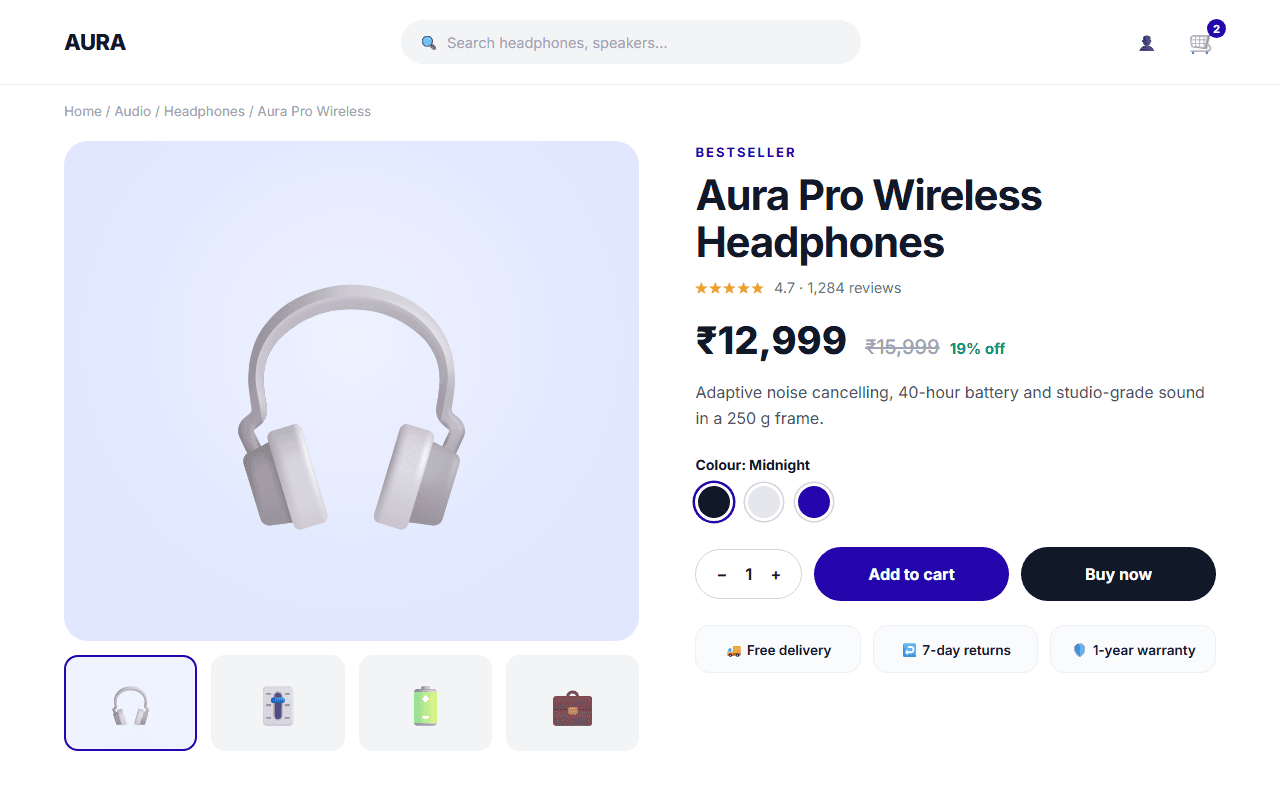
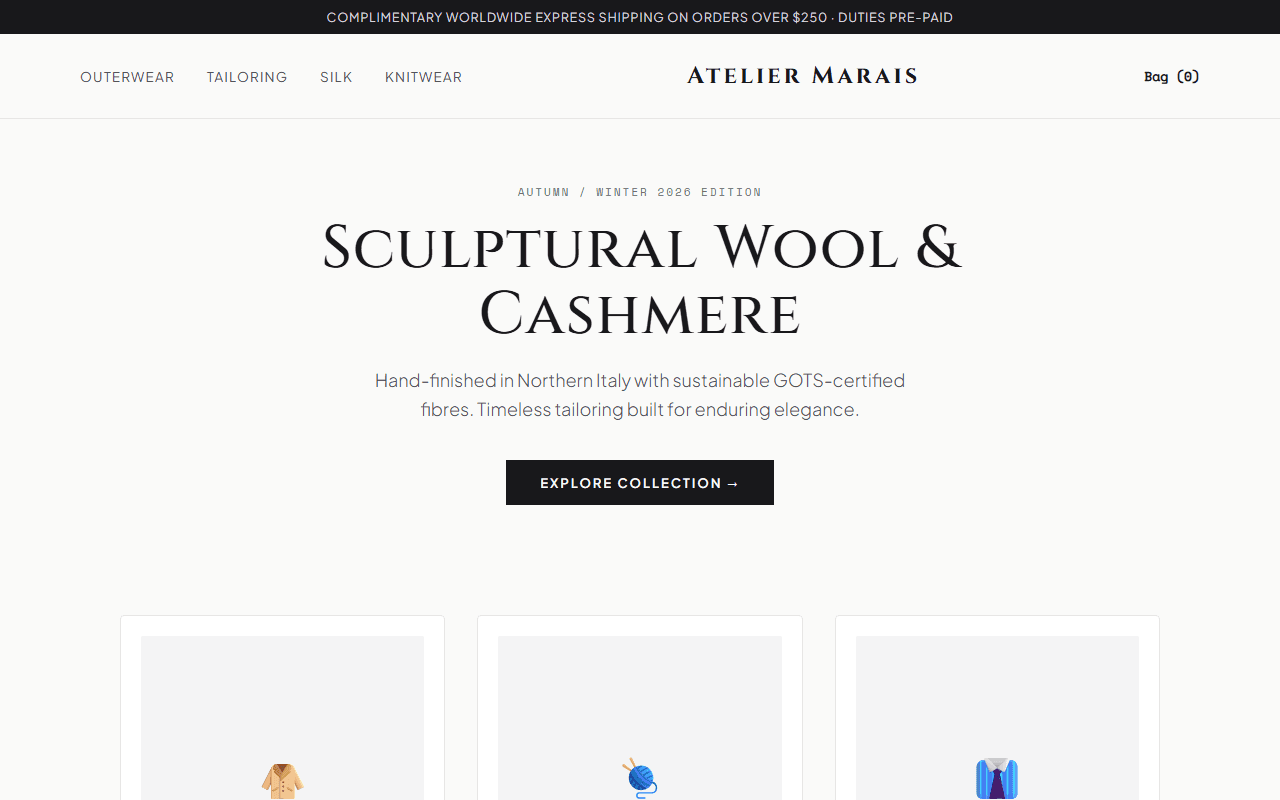
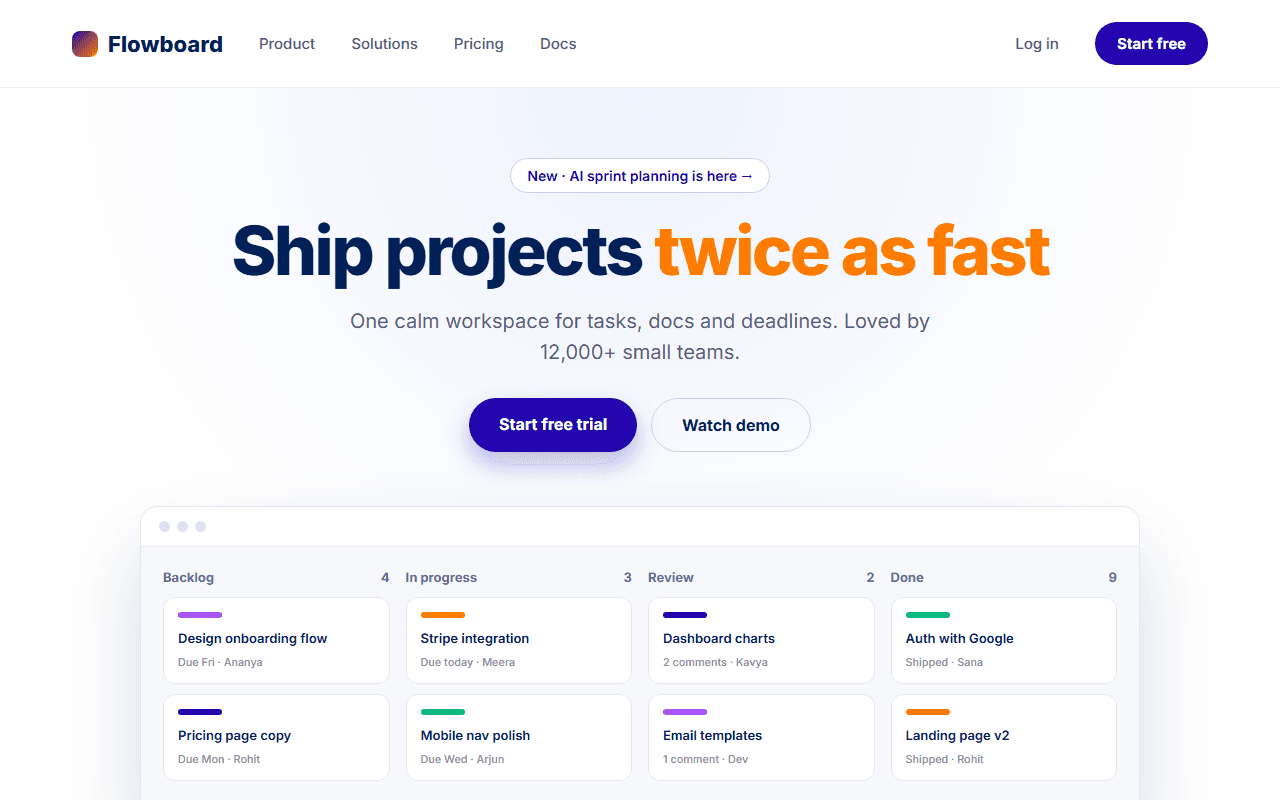
Grocery Delivery App
A quick-commerce grocery website with a delivery-location hero, categories, deals, product cards with add-to-cart steppers and an app download section.
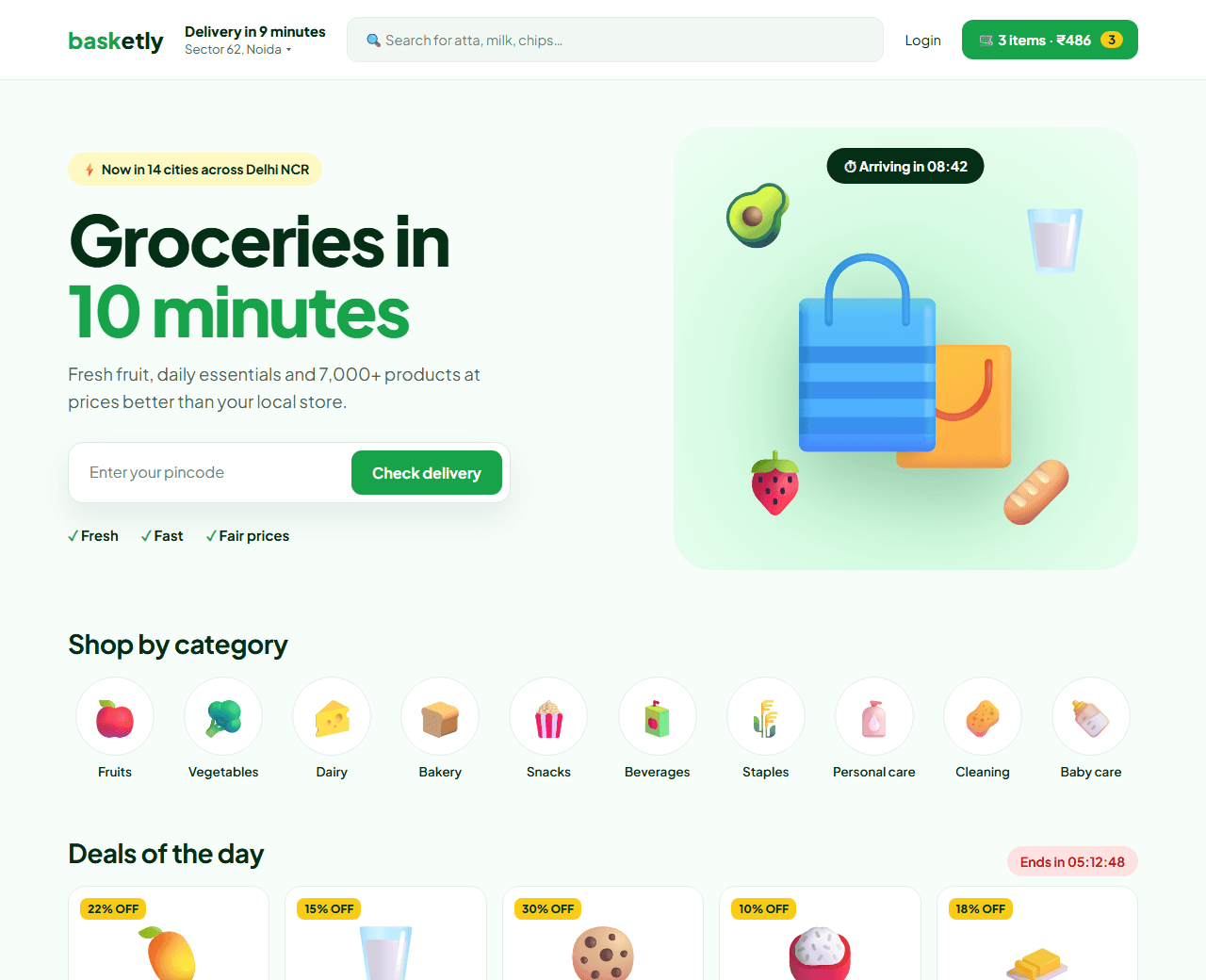
Example of the website this prompt builds. Your result will use your own name, text and images.
- Tech stack
- Next.js (App Router) + Tailwind CSS
- Colour palette
#f7fdf9#052e16#16a34a#facc15
- What it builds
- Navbar with cart
- Location hero
- Shop by category
- Deals of the day
- Best sellers
- How it works
- App download
- Reviews
- Footer
Build the whole website step by step
18 prompts, in order. Paste step 1 into Claude, ChatGPT, Cursor or any AI coding tool, wait until that part works, then paste the next one in the same chat. Each step builds one piece: the project setup, every section of the home page, the extra pages a real E-commerce website needs, and finally polish, SEO and launch. Type your business name and colours in "Make it yours" first and every prompt updates for you. Tick off steps as you go; your progress is saved in this browser.
Make it yours
Fill in your own details and every prompt below updates, so you don't have to edit them by hand. All fields are optional.
Setup1 step
Set up the project and design systemUp next
A running Next.js app with colours, fonts and reusable UI components, ready for sections.
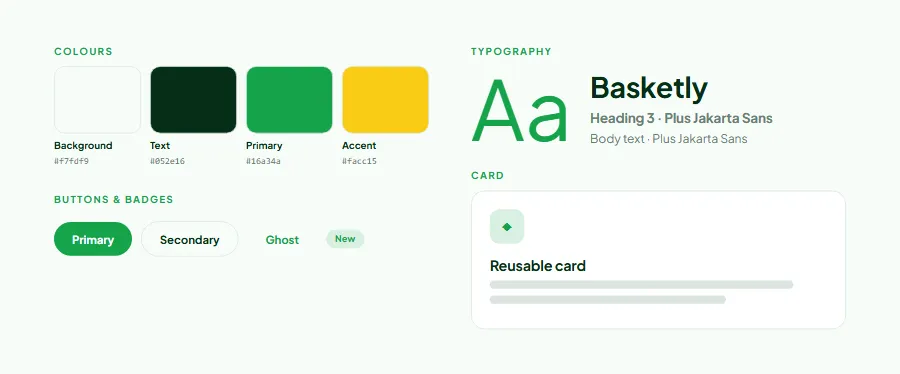
Copy step 1, paste it into your AI tool in the same chat, and you will get a result like the preview.
Show the prompt for step 1
Build a complete website for a 10-minute grocery delivery service called "Basketly", operating in Delhi NCR.

We will build this step by step. In this first step, ONLY set up the project and the design system — do not build any page sections yet.

Tech stack: Next.js (App Router) with Tailwind CSS. Components in a components/ folder; product data in a local file; cart state in a small React context saved to localStorage.

Visual style: fresh, cheerful and fast. Mint white background (#f7fdf9), deep green text (#052e16), fresh green (#16a34a) for buttons, and sunny yellow (#facc15) for deal badges. A friendly rounded sans-serif such as Plus Jakarta Sans, rounded 16px cards, clear product photos on white.

Do the following:
1. Give me the exact commands to create the project (npx create-next-app@latest with the App Router, JavaScript or TypeScript, Tailwind CSS, ESLint) and how to run it.
2. Set up the colour palette (#f7fdf9, #052e16, #16a34a, #facc15) as Tailwind theme colours / CSS variables with clear names (background, text, primary, accent, muted, border).
3. Load the fonts with next/font and set the base typography scale (h1–h4, body, small).
4. Create reusable components in components/ui: Container, SectionHeading (eyebrow + title + subtitle), Button (primary, secondary, ghost; sizes), Card and Badge.
5. Create app/layout.js with the font, metadata placeholders and a <main> wrapper, and an app/page.js that shows a temporary list of the sections we will build: Navbar, Hero, Shop by category, Deals of the day, Best sellers, How it works, App download, Reviews, Footer.
6. Show the final folder structure.

Explain briefly what each file does. Keep the code clean and commented.
Home page10 steps
Navbar
Logo, a delivery location selector ("Delivering to Sector 62, Noida"), a product search field, "Login" and a cart…
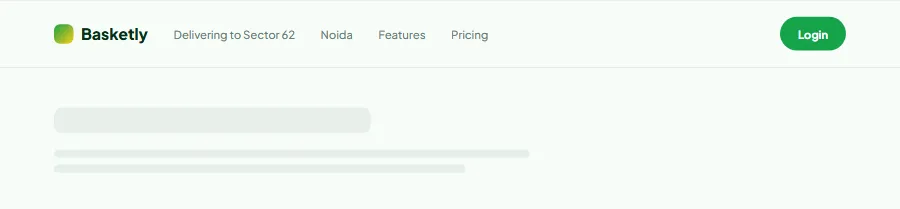
Copy step 2, paste it into your AI tool in the same chat, and you will get a result like the preview, in your own colours and content.
Show the prompt for step 2
Project recap: we are building Basketly — A quick-commerce grocery website with a delivery-location hero, categories, deals, product cards with add-to-cart steppers and an app download section. Stack: Next.js (App Router) + Tailwind CSS. Keep using the design system, colours, fonts and components we already created; do not rewrite earlier sections. Now build ONLY section 1 of 9: Navbar. Requirements: logo, a delivery location selector ("Delivering to Sector 62, Noida"), a product search field, "Login" and a cart button with item count and total. Create it as components/Navbar.jsx (a Server Component unless it needs state or event handlers — then add "use client" and keep the interactive part as small as possible), and add it to app/page.js in position 1. Rules: - Use only the existing design tokens and UI components; add new tokens only if truly needed and tell me. - Mobile-first and responsive at 375px, 768px and 1200px+. - Accessible: semantic elements, correct heading level (only the hero uses h1), alt text, keyboard focus styles, labels on any form fields. - Realistic sample content for Basketly (no lorem ipsum). - Show me the complete code for every file you create or change.Hero
Split layout with the headline "Groceries in 10 minutes", a pincode field with a "Check delivery" button, three trust…
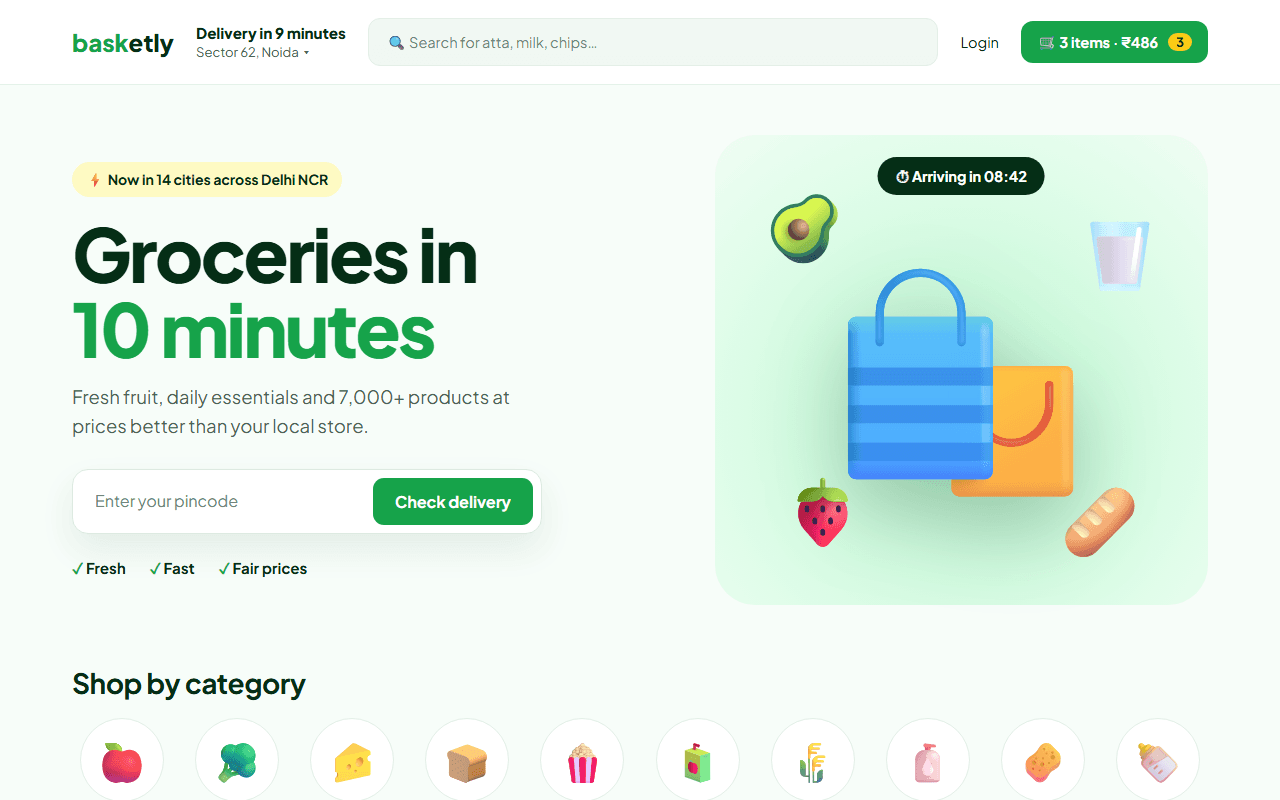
Copy step 3, paste it into your AI tool in the same chat, and you will get a result like the preview, in your own colours and content.
Show the prompt for step 3
Project recap: we are building Basketly — A quick-commerce grocery website with a delivery-location hero, categories, deals, product cards with add-to-cart steppers and an app download section. Stack: Next.js (App Router) + Tailwind CSS. Keep using the design system, colours, fonts and components we already created; do not rewrite earlier sections.

Now build ONLY section 2 of 9: Hero.

Requirements:
split layout with the headline "Groceries in 10 minutes", a pincode field with a "Check delivery" button, three trust points (Fresh, Fast, Fair prices) and a photo of a filled grocery bag.

Create it as components/Hero.jsx (a Server Component unless it needs state or event handlers — then add "use client" and keep the interactive part as small as possible), and add it to app/page.js in position 2.

Rules:
- Use only the existing design tokens and UI components; add new tokens only if truly needed and tell me.
- Mobile-first and responsive at 375px, 768px and 1200px+.
- Accessible: semantic elements, correct heading level (only the hero uses h1), alt text, keyboard focus styles, labels on any form fields.
- Realistic sample content for Basketly (no lorem ipsum).
- Show me the complete code for every file you create or change.
Shop by category
Ten round category tiles (Fruits, Vegetables, Dairy, Bakery, Snacks, Beverages, Staples, Personal care, Cleaning,…
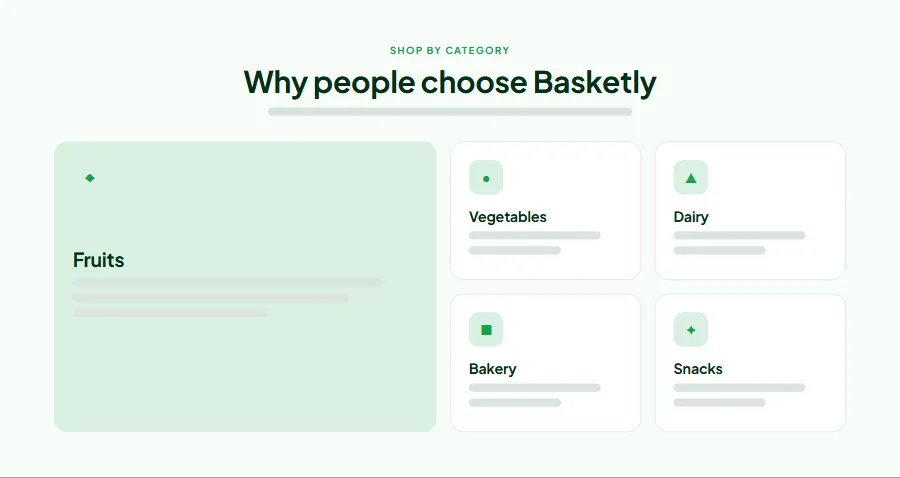
Copy step 4, paste it into your AI tool in the same chat, and you will get a result like the preview, in your own colours and content.
Show the prompt for step 4
Project recap: we are building Basketly — A quick-commerce grocery website with a delivery-location hero, categories, deals, product cards with add-to-cart steppers and an app download section. Stack: Next.js (App Router) + Tailwind CSS. Keep using the design system, colours, fonts and components we already created; do not rewrite earlier sections.

Now build ONLY section 3 of 9: Shop by category.

Requirements:
ten round category tiles (Fruits, Vegetables, Dairy, Bakery, Snacks, Beverages, Staples, Personal care, Cleaning, Baby care).

Create it as components/ShopByCategory.jsx (a Server Component unless it needs state or event handlers — then add "use client" and keep the interactive part as small as possible), and add it to app/page.js in position 3.

Rules:
- Use only the existing design tokens and UI components; add new tokens only if truly needed and tell me.
- Mobile-first and responsive at 375px, 768px and 1200px+.
- Accessible: semantic elements, correct heading level (only the hero uses h1), alt text, keyboard focus styles, labels on any form fields.
- Realistic sample content for Basketly (no lorem ipsum).
- Show me the complete code for every file you create or change.
Deals of the day
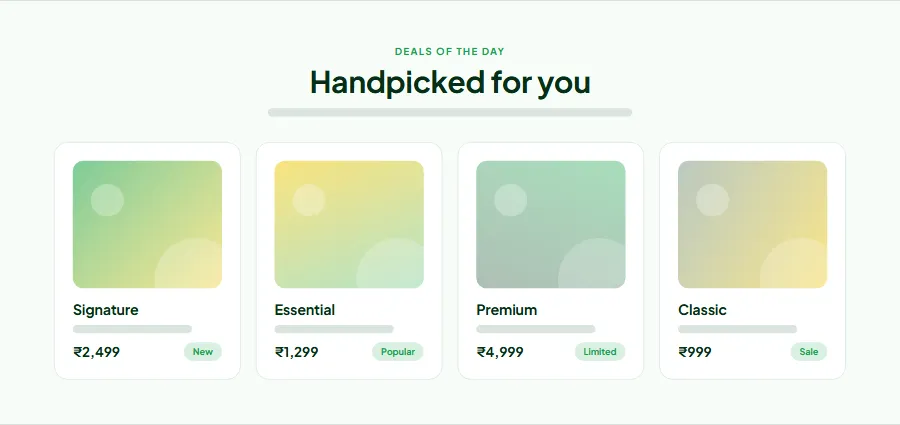
A horizontally scrolling row of product cards with discount badge, MRP struck through and an end-of-day countdown.
Copy step 5, paste it into your AI tool in the same chat, and you will get a result like the preview, in your own colours and content.
Show the prompt for step 5
Project recap: we are building Basketly — A quick-commerce grocery website with a delivery-location hero, categories, deals, product cards with add-to-cart steppers and an app download section. Stack: Next.js (App Router) + Tailwind CSS. Keep using the design system, colours, fonts and components we already created; do not rewrite earlier sections.

Now build ONLY section 4 of 9: Deals of the day.

Requirements:
a horizontally scrolling row of product cards with discount badge, MRP struck through and an end-of-day countdown.

Create it as components/DealsOfThe.jsx (a Server Component unless it needs state or event handlers — then add "use client" and keep the interactive part as small as possible), and add it to app/page.js in position 4.

Rules:
- Use only the existing design tokens and UI components; add new tokens only if truly needed and tell me.
- Mobile-first and responsive at 375px, 768px and 1200px+.
- Accessible: semantic elements, correct heading level (only the hero uses h1), alt text, keyboard focus styles, labels on any form fields.
- Realistic sample content for Basketly (no lorem ipsum).
- Show me the complete code for every file you create or change.
Best sellers
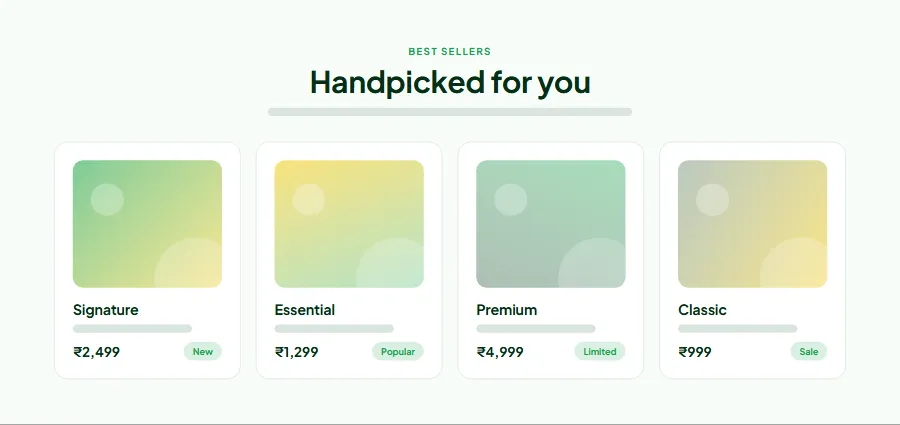
A grid of eight product cards with photo, name, pack size, price and an "Add" button that turns into a quantity stepper.
Copy step 6, paste it into your AI tool in the same chat, and you will get a result like the preview, in your own colours and content.
Show the prompt for step 6
Project recap: we are building Basketly — A quick-commerce grocery website with a delivery-location hero, categories, deals, product cards with add-to-cart steppers and an app download section. Stack: Next.js (App Router) + Tailwind CSS. Keep using the design system, colours, fonts and components we already created; do not rewrite earlier sections.

Now build ONLY section 5 of 9: Best sellers.

Requirements:
a grid of eight product cards with photo, name, pack size, price and an "Add" button that turns into a quantity stepper.

Create it as components/BestSellers.jsx (a Server Component unless it needs state or event handlers — then add "use client" and keep the interactive part as small as possible), and add it to app/page.js in position 5.

Rules:
- Use only the existing design tokens and UI components; add new tokens only if truly needed and tell me.
- Mobile-first and responsive at 375px, 768px and 1200px+.
- Accessible: semantic elements, correct heading level (only the hero uses h1), alt text, keyboard focus styles, labels on any form fields.
- Realistic sample content for Basketly (no lorem ipsum).
- Show me the complete code for every file you create or change.
How it works
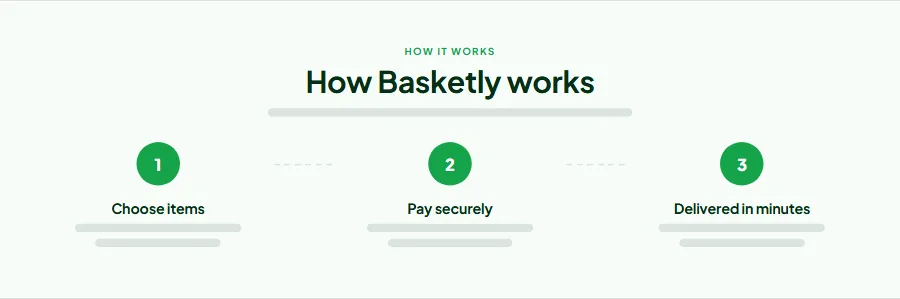
Three steps (Choose items, Pay securely, Delivered in minutes).
Copy step 7, paste it into your AI tool in the same chat, and you will get a result like the preview, in your own colours and content.
Show the prompt for step 7
Project recap: we are building Basketly — A quick-commerce grocery website with a delivery-location hero, categories, deals, product cards with add-to-cart steppers and an app download section. Stack: Next.js (App Router) + Tailwind CSS. Keep using the design system, colours, fonts and components we already created; do not rewrite earlier sections.

Now build ONLY section 6 of 9: How it works.

Requirements:
three steps (Choose items, Pay securely, Delivered in minutes).

Create it as components/HowItWorks.jsx (a Server Component unless it needs state or event handlers — then add "use client" and keep the interactive part as small as possible), and add it to app/page.js in position 6.

Rules:
- Use only the existing design tokens and UI components; add new tokens only if truly needed and tell me.
- Mobile-first and responsive at 375px, 768px and 1200px+.
- Accessible: semantic elements, correct heading level (only the hero uses h1), alt text, keyboard focus styles, labels on any form fields.
- Realistic sample content for Basketly (no lorem ipsum).
- Show me the complete code for every file you create or change.
App download
A band with a phone mockup, rating and app store badges.
Copy step 8, paste it into your AI tool in the same chat, and you will get a result like the preview, in your own colours and content.
Show the prompt for step 8
Project recap: we are building Basketly — A quick-commerce grocery website with a delivery-location hero, categories, deals, product cards with add-to-cart steppers and an app download section. Stack: Next.js (App Router) + Tailwind CSS. Keep using the design system, colours, fonts and components we already created; do not rewrite earlier sections.

Now build ONLY section 7 of 9: App download.

Requirements:
a band with a phone mockup, rating and app store badges.

Create it as components/AppDownload.jsx (a Server Component unless it needs state or event handlers — then add "use client" and keep the interactive part as small as possible), and add it to app/page.js in position 7.

Rules:
- Use only the existing design tokens and UI components; add new tokens only if truly needed and tell me.
- Mobile-first and responsive at 375px, 768px and 1200px+.
- Accessible: semantic elements, correct heading level (only the hero uses h1), alt text, keyboard focus styles, labels on any form fields.
- Realistic sample content for Basketly (no lorem ipsum).
- Show me the complete code for every file you create or change.
Reviews
Three customer reviews with rating and area.
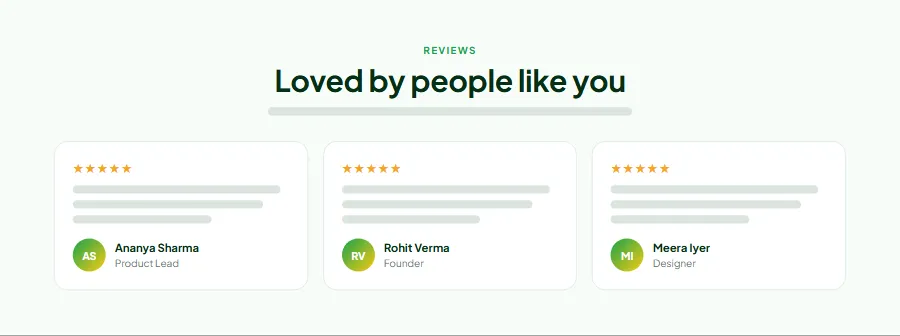
Copy step 9, paste it into your AI tool in the same chat, and you will get a result like the preview, in your own colours and content.
Show the prompt for step 9
Project recap: we are building Basketly — A quick-commerce grocery website with a delivery-location hero, categories, deals, product cards with add-to-cart steppers and an app download section. Stack: Next.js (App Router) + Tailwind CSS. Keep using the design system, colours, fonts and components we already created; do not rewrite earlier sections.

Now build ONLY section 8 of 9: Reviews.

Requirements:
three customer reviews with rating and area.

Create it as components/Reviews.jsx (a Server Component unless it needs state or event handlers — then add "use client" and keep the interactive part as small as possible), and add it to app/page.js in position 8.

Rules:
- Use only the existing design tokens and UI components; add new tokens only if truly needed and tell me.
- Mobile-first and responsive at 375px, 768px and 1200px+.
- Accessible: semantic elements, correct heading level (only the hero uses h1), alt text, keyboard focus styles, labels on any form fields.
- Realistic sample content for Basketly (no lorem ipsum).
- Show me the complete code for every file you create or change.
Footer
Categories, company links, cities served and copyright.
Copy step 10, paste it into your AI tool in the same chat, and you will get a result like the preview, in your own colours and content.
Show the prompt for step 10
Project recap: we are building Basketly — A quick-commerce grocery website with a delivery-location hero, categories, deals, product cards with add-to-cart steppers and an app download section. Stack: Next.js (App Router) + Tailwind CSS. Keep using the design system, colours, fonts and components we already created; do not rewrite earlier sections.

Now build ONLY section 9 of 9: Footer.

Requirements:
categories, company links, cities served and copyright.

Create it as components/Footer.jsx (a Server Component unless it needs state or event handlers — then add "use client" and keep the interactive part as small as possible), and add it to app/page.js in position 9.

Rules:
- Use only the existing design tokens and UI components; add new tokens only if truly needed and tell me.
- Mobile-first and responsive at 375px, 768px and 1200px+.
- Accessible: semantic elements, correct heading level (only the hero uses h1), alt text, keyboard focus styles, labels on any form fields.
- Realistic sample content for Basketly (no lorem ipsum).
- Show me the complete code for every file you create or change.
Interactions and animation
Hover states, scroll reveals and any interactive behaviour, without hurting performance.
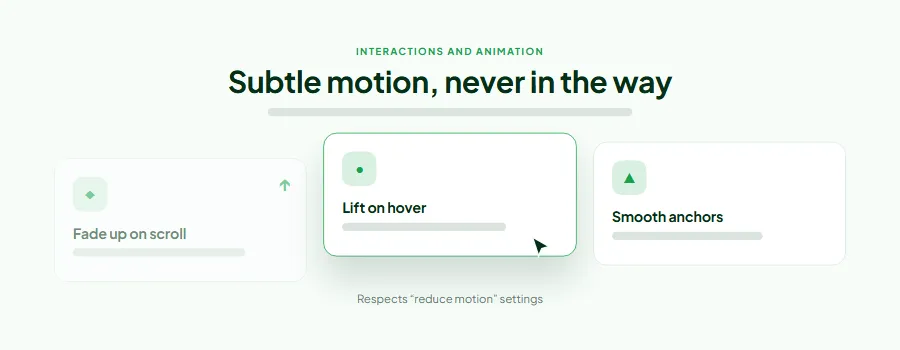
Copy step 11, paste it into your AI tool in the same chat, and you will get a result like the preview, in your own colours and content.
Show the prompt for step 11
Project recap: we are building Basketly — A quick-commerce grocery website with a delivery-location hero, categories, deals, product cards with add-to-cart steppers and an app download section. Stack: Next.js (App Router) + Tailwind CSS. Keep using the design system, colours, fonts and components we already created; do not rewrite earlier sections.

All sections are built. Now add the interactions and animation layer.

Required behaviour:
adding items updates the navbar cart count and total instantly; the stepper never goes below zero (zero removes the item); the deals countdown ticks every second.

Also:
- Subtle hover and focus states on every link, button and card.
- Elements fade and slide up slightly as they scroll into view (IntersectionObserver in one small client component); run each animation once.
- Smooth scrolling for in-page links, with an offset for the sticky header.
- Every animation must be disabled when the user has prefers-reduced-motion set.
- Do not add heavy animation libraries. Show the full code of each changed file.
More pages4 steps
Catalogue page
A new /shop page that matches the rest of the site.
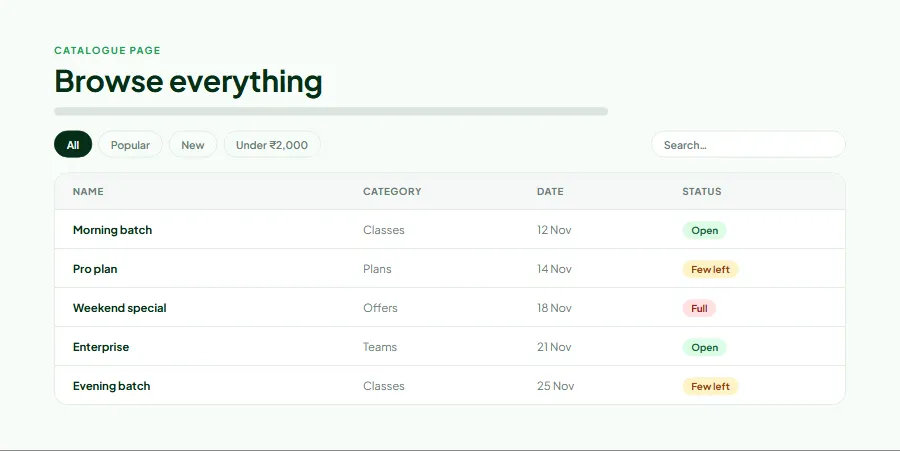
Copy step 12, paste it into your AI tool in the same chat, and you will get a result like the preview, in your own colours and content.
Show the prompt for step 12
Project recap: we are building Basketly — A quick-commerce grocery website with a delivery-location hero, categories, deals, product cards with add-to-cart steppers and an app download section. Stack: Next.js (App Router) + Tailwind CSS. Keep using the design system, colours, fonts and components we already created; do not rewrite earlier sections.

The home page is finished. Now add a product listing page with a filter sidebar (category, price range, colour), sort options, a product grid from a local data file and pagination.

Route: /shop.
- Move the Navbar and Footer into app/layout.js (if not already there) so every page shares them, and add a link to this page in the navigation.
- Put shared mock data in a lib/ or data/ file, not inside the component.
- Give the page its own metadata (title and description).
- Same design system and components, responsive and accessible as before.
- Show the full code for every new or changed file.
Product page
A new /product/[slug] page that matches the rest of the site.
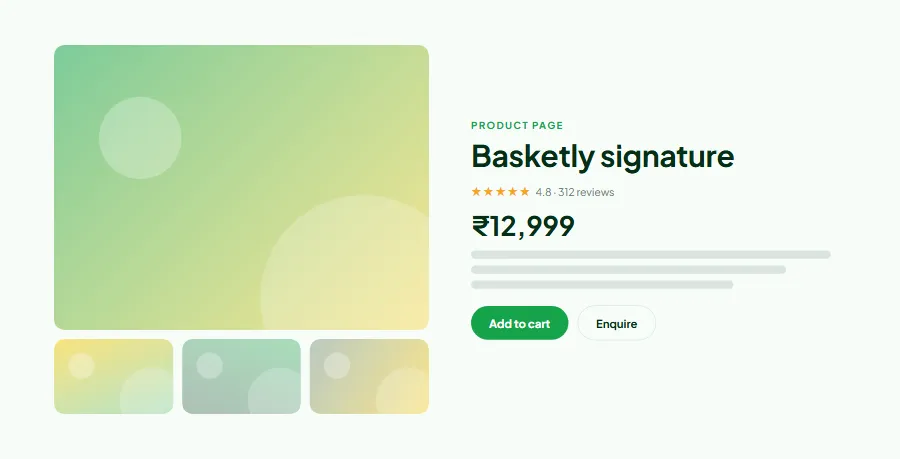
Copy step 13, paste it into your AI tool in the same chat, and you will get a result like the preview, in your own colours and content.
Show the prompt for step 13
Project recap: we are building Basketly — A quick-commerce grocery website with a delivery-location hero, categories, deals, product cards with add-to-cart steppers and an app download section. Stack: Next.js (App Router) + Tailwind CSS. Keep using the design system, colours, fonts and components we already created; do not rewrite earlier sections.

The home page is finished. Now add a product detail page generated from the same data file, reusing the gallery, variant picker and add-to-cart components.

Route: /product/[slug].
- Move the Navbar and Footer into app/layout.js (if not already there) so every page shares them, and add a link to this page in the navigation.
- Put shared mock data in a lib/ or data/ file, not inside the component.
- Give the page its own metadata (title and description).
- Same design system and components, responsive and accessible as before.
- Show the full code for every new or changed file.
Cart
A new /cart page that matches the rest of the site.
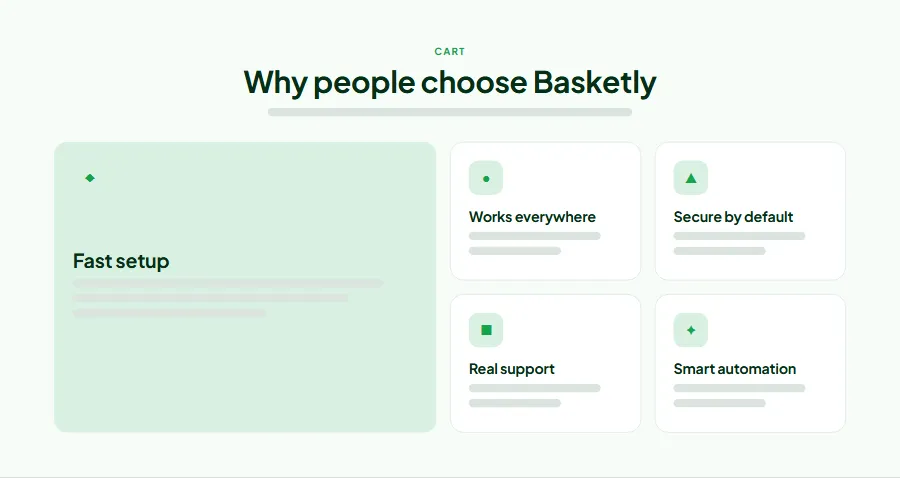
Copy step 14, paste it into your AI tool in the same chat, and you will get a result like the preview, in your own colours and content.
Show the prompt for step 14
Project recap: we are building Basketly — A quick-commerce grocery website with a delivery-location hero, categories, deals, product cards with add-to-cart steppers and an app download section. Stack: Next.js (App Router) + Tailwind CSS. Keep using the design system, colours, fonts and components we already created; do not rewrite earlier sections.

The home page is finished. Now add a cart page backed by React context + localStorage: line items, quantity steppers, remove, coupon field (UI only), subtotal, shipping and total.

Route: /cart.
- Move the Navbar and Footer into app/layout.js (if not already there) so every page shares them, and add a link to this page in the navigation.
- Put shared mock data in a lib/ or data/ file, not inside the component.
- Give the page its own metadata (title and description).
- Same design system and components, responsive and accessible as before.
- Show the full code for every new or changed file.
Checkout and confirmation
A new /checkout and /order/success page that matches the rest of the site.
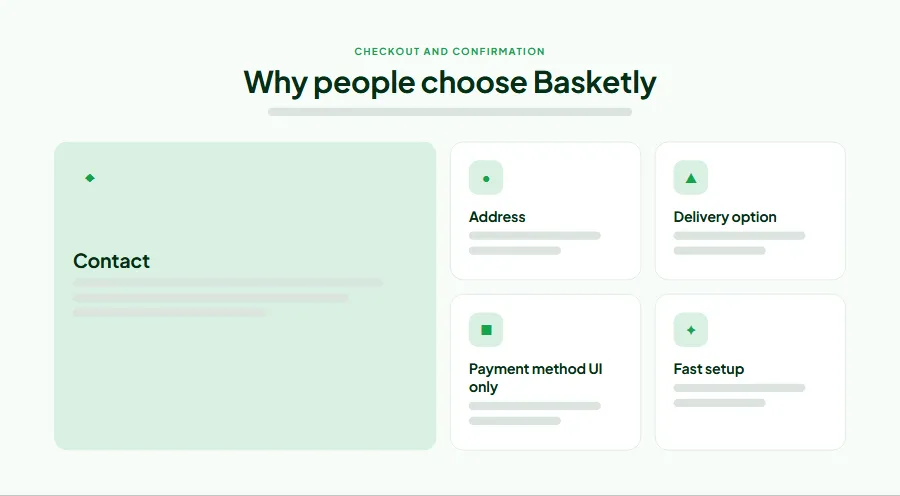
Copy step 15, paste it into your AI tool in the same chat, and you will get a result like the preview, in your own colours and content.
Show the prompt for step 15
Project recap: we are building Basketly — A quick-commerce grocery website with a delivery-location hero, categories, deals, product cards with add-to-cart steppers and an app download section. Stack: Next.js (App Router) + Tailwind CSS. Keep using the design system, colours, fonts and components we already created; do not rewrite earlier sections.

The home page is finished. Now add a checkout form (contact, address, delivery option, payment method UI only) with validation, then an order confirmation page with an order summary.

Route: /checkout and /order/success.
- Move the Navbar and Footer into app/layout.js (if not already there) so every page shares them, and add a link to this page in the navigation.
- Put shared mock data in a lib/ or data/ file, not inside the component.
- Give the page its own metadata (title and description).
- Same design system and components, responsive and accessible as before.
- Show the full code for every new or changed file.
Polish and launch3 steps
Responsive and accessibility review
A page that works on every screen size and with a keyboard or screen reader.
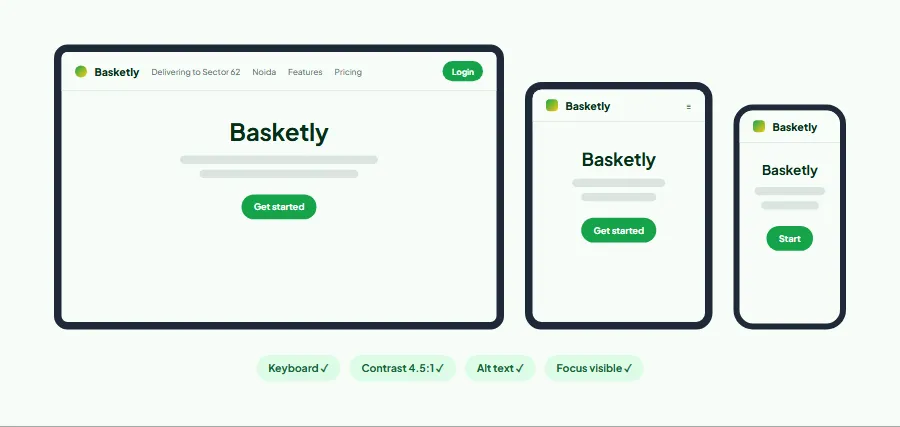
Copy step 16, paste it into your AI tool in the same chat, and you will get a result like the preview, in your own colours and content.
Show the prompt for step 16
Project recap: we are building Basketly — A quick-commerce grocery website with a delivery-location hero, categories, deals, product cards with add-to-cart steppers and an app download section. Stack: Next.js (App Router) + Tailwind CSS. Keep using the design system, colours, fonts and components we already created; do not rewrite earlier sections.

Review the whole site and fix problems. Go through it at 360px, 768px, 1024px and 1440px widths and check:
- No horizontal scrolling, nothing overlapping, text never cut off, tap targets at least 44px.
- One h1 per page and a logical heading order; landmarks (header, nav, main, footer).
- Every image has meaningful alt text (or empty alt if decorative); every form field has a label and error messages are announced.
- Everything works with the keyboard alone, focus is always visible, and menus/accordions/modals manage focus and close with Escape.
- Colour contrast of at least 4.5:1 for body text.
List each issue you found and the fix, then show the changed code.
SEO and performance
Search-friendly metadata, social previews and fast loading.
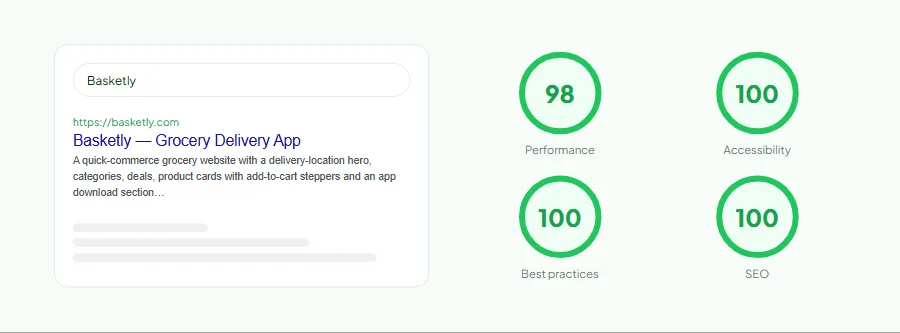
Copy step 17, paste it into your AI tool in the same chat, and you will get a result like the preview, in your own colours and content.
Show the prompt for step 17
Project recap: we are building Basketly — A quick-commerce grocery website with a delivery-location hero, categories, deals, product cards with add-to-cart steppers and an app download section. Stack: Next.js (App Router) + Tailwind CSS. Keep using the design system, colours, fonts and components we already created; do not rewrite earlier sections.

Prepare the site for search engines and fast loading:
- Metadata for every page (title, description, canonical, Open Graph and Twitter card) using the Metadata API, and a title template.
- app/sitemap.js and app/robots.js.
- JSON-LD structured data that fits Basketly (Organization or LocalBusiness, plus FAQPage if there is an FAQ).
- Use next/image with correct sizes for every image, preload only the hero image, and lazy-load the rest.
- Make sure no component is a Client Component unless it needs to be.
Then tell me how to check the result with Lighthouse and what score to aim for.
Launch
The website live on the internet with your own domain.
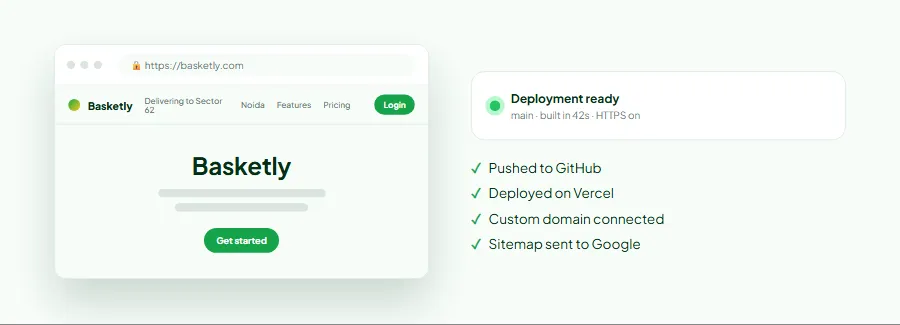
Copy step 18, paste it into your AI tool in the same chat, and you will get a result like the preview, in your own colours and content.
Show the prompt for step 18
Project recap: we are building Basketly — A quick-commerce grocery website with a delivery-location hero, categories, deals, product cards with add-to-cart steppers and an app download section. Stack: Next.js (App Router) + Tailwind CSS. Keep using the design system, colours, fonts and components we already created; do not rewrite earlier sections.

The site is ready. Walk me through launching it, step by step, for a beginner:
1. Push the project to a new GitHub repository (exact git commands).
2. Deploy it on Vercel (free plan) from that repository.
3. Connect a custom domain and set up HTTPS.
4. Add any environment variables the project needs.
5. Submit the sitemap to Google Search Console.
6. A final pre-launch checklist: replace all sample text, images, prices and contact details with real ones, test every link and form, and check it on a real phone.
Or: the one-shot prompt
Prefer to generate the home page in one go? Copy everything in the box. It works best in tools that can write many files at once (Cursor, Claude Code, v0, Bolt). Text in quotes and the sample business details are meant to be replaced with your own.
Build a complete website for a 10-minute grocery delivery service called "Basketly", operating in Delhi NCR.

Tech stack: Next.js (App Router) with Tailwind CSS. Components in a components/ folder; product data in a local file; cart state in a small React context saved to localStorage.

Visual style: fresh, cheerful and fast. Mint white background (#f7fdf9), deep green text (#052e16), fresh green (#16a34a) for buttons, and sunny yellow (#facc15) for deal badges. A friendly rounded sans-serif such as Plus Jakarta Sans, rounded 16px cards, clear product photos on white.

Sections, in order:
1. Navbar: logo, a delivery location selector ("Delivering to Sector 62, Noida"), a product search field, "Login" and a cart button with item count and total.
2. Hero: split layout with the headline "Groceries in 10 minutes", a pincode field with a "Check delivery" button, three trust points (Fresh, Fast, Fair prices) and a photo of a filled grocery bag.
3. Shop by category: ten round category tiles (Fruits, Vegetables, Dairy, Bakery, Snacks, Beverages, Staples, Personal care, Cleaning, Baby care).
4. Deals of the day: a horizontally scrolling row of product cards with discount badge, MRP struck through and an end-of-day countdown.
5. Best sellers: a grid of eight product cards with photo, name, pack size, price and an "Add" button that turns into a quantity stepper.
6. How it works: three steps (Choose items, Pay securely, Delivered in minutes).
7. App download: a band with a phone mockup, rating and app store badges.
8. Reviews: three customer reviews with rating and area.
9. Footer: categories, company links, cities served and copyright.

Interactions: adding items updates the navbar cart count and total instantly; the stepper never goes below zero (zero removes the item); the deals countdown ticks every second.

Quality bar:
- Fully responsive: design mobile-first, then tablet (768px) and desktop (1200px).
- Accessible: semantic HTML landmarks, one h1, alt text on images, visible keyboard focus, colour contrast of at least 4.5:1 for body text.
- Fast: no heavy libraries, lazy-load images below the fold, system or two web fonts at most.
- Use placeholder images from a neutral source and realistic sample copy (no lorem ipsum).
- Respect prefers-reduced-motion for every animation.
- Keep the code clean and commented so I can edit it by hand.
How to use these prompts
- 1
Open an AI coding tool. Use any capable assistant: Claude, ChatGPT, Cursor, v0, Bolt, Gemini. Tools that can create files (Cursor, Claude Code, v0, Bolt) are the most convenient because they write the project for you.
- 2
Replace the sample details. Copy the prompt and change the business name, location, colours and any section you do not need. The more specific your details, the better the result.
- 3
Paste the prompts one by one. Start with step 1 of the step-by-step build and send each next step only when the previous one works. If a reply is cut off, say “continue from where you stopped”. Or send the one-shot prompt if you want the whole home page at once.
- 4
Run it on your computer. Create a project with “npx create-next-app@latest”, add the generated files, then run “npm run dev” and open http://localhost:3000.
- 5
Review and refine. Check it on a phone-width screen, fix anything that looks off by describing it in plain words, then use the follow-up prompts below to add features one at a time.
- 6
Replace placeholders and publish. Swap in your real text and images, then deploy. Vercel and Netlify both host this kind of site for free.
Follow-up prompts
Send these one at a time after the first version is working. Small, specific requests give much better results than one giant prompt.
Build a slide-in cart drawer with line items, a free-delivery progress bar (free above ₹199), coupon field and checkout button.
Build /category/[slug] with filters (brand, price, discount) and sort options.
Build a checkout page with address selection, delivery slot and payment method (UI only).
Add Product and Offer JSON-LD to product cards.
Tips for a better result
- Replace product images with real packshots on a white background; consistency makes the grid look premium.
- Show the delivery time and fee before checkout; surprises at checkout lose orders.
- Want to hand-build a section instead? The Templates library has heroes, pricing tables, FAQs and more with full code.