Personal Blog & Newsletter
A calm, reading-first personal blog and newsletter with a subscribe hero, featured essay, latest posts, topics, newsletter archive and author section.
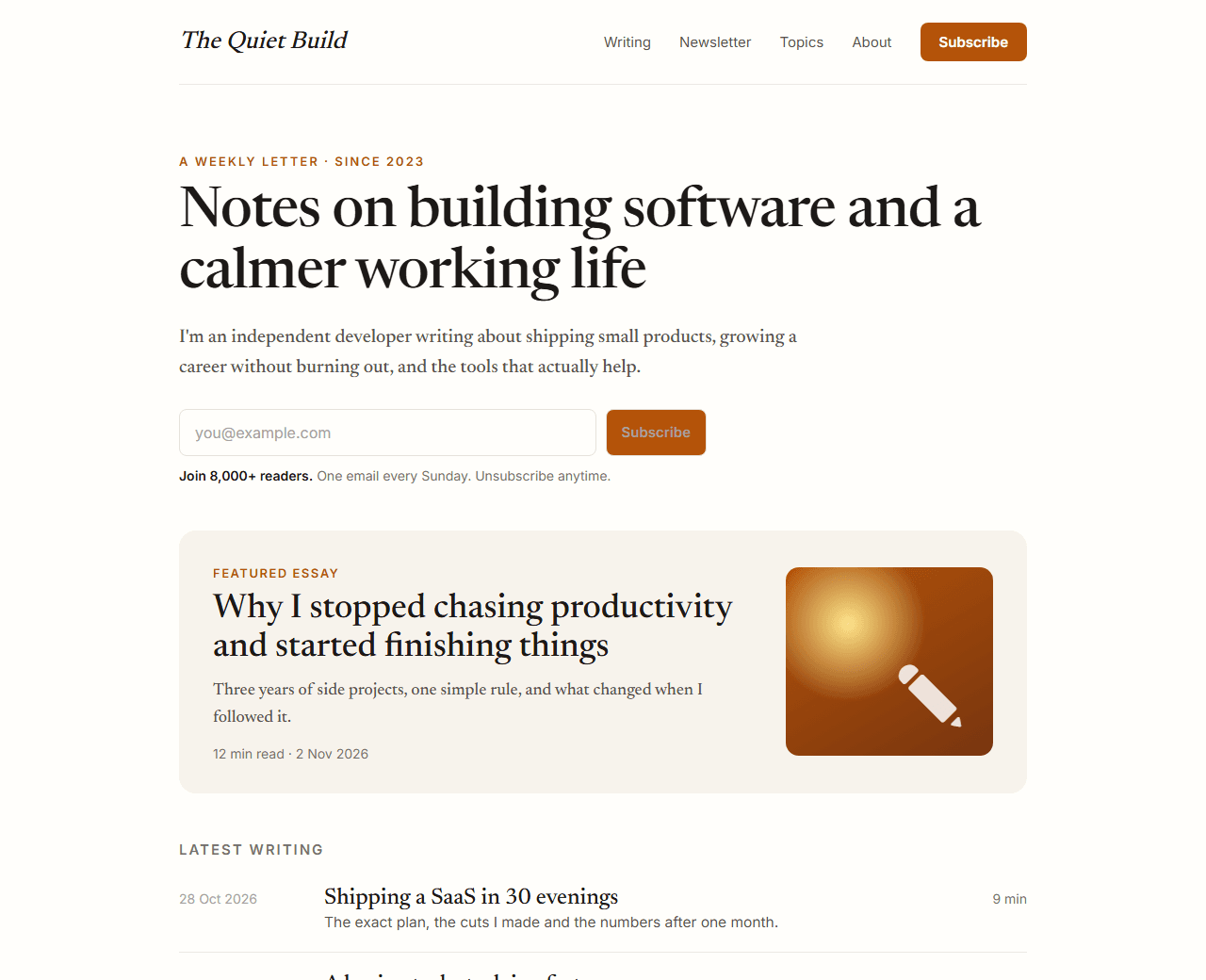
Example of the website this prompt builds. Your result will use your own name, text and images.
- Tech stack
- Next.js (App Router) + Tailwind CSS + Markdown
- Colour palette
#fffefb#1c1917#b45309#57534e
- What it builds
- Navbar
- Intro hero with subscribe
- Featured essay
- Latest posts
- Topics
- Newsletter archive
- About the author
- Reader notes
- Footer
Build the whole website step by step
17 prompts, in order. Paste step 1 into Claude, ChatGPT, Cursor or any AI coding tool, wait until that part works, then paste the next one in the same chat. Each step builds one piece: the project setup, every section of the home page, the extra pages a real Personal website needs, and finally polish, SEO and launch. Type your business name and colours in "Make it yours" first and every prompt updates for you. Tick off steps as you go; your progress is saved in this browser.
Make it yours
Fill in your own details and every prompt below updates, so you don't have to edit them by hand. All fields are optional.
Setup1 step
Set up the project and design systemUp next
A running Next.js app with colours, fonts and reusable UI components, ready for sections.
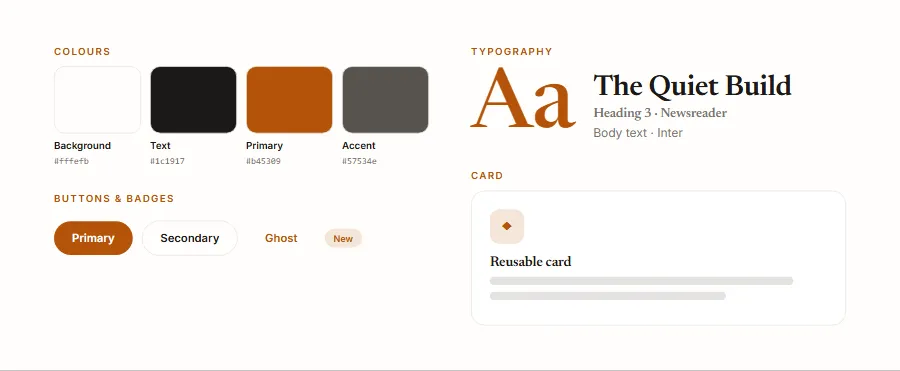
Copy step 1, paste it into your AI tool in the same chat, and you will get a result like the preview.
Show the prompt for step 1
Build a complete personal blog and newsletter website called "The Quiet Build", written by an independent software developer about building products, careers and calm productivity.

We will build this step by step. In this first step, ONLY set up the project and the design system — do not build any page sections yet.

Tech stack: Next.js (App Router) with Tailwind CSS. Posts are Markdown files in a content/ folder, read at build time. Server Components everywhere except the subscribe form.

Visual style: reading-first, warm and minimal. Paper white background (#fffefb), ink text (#1c1917), burnt amber (#b45309) for links and the subscribe button, and stone grey (#57534e) for dates and meta. A readable serif for headings and articles (such as Newsreader) with a small sans-serif for the interface. Line length around 65 characters, generous line height, no sidebars.

Do the following:
1. Give me the exact commands to create the project (npx create-next-app@latest with the App Router, JavaScript or TypeScript, Tailwind CSS, ESLint) and how to run it.
2. Set up the colour palette (#fffefb, #1c1917, #b45309, #57534e) as Tailwind theme colours / CSS variables with clear names (background, text, primary, accent, muted, border).
3. Load the fonts with next/font and set the base typography scale (h1–h4, body, small).
4. Create reusable components in components/ui: Container, SectionHeading (eyebrow + title + subtitle), Button (primary, secondary, ghost; sizes), Card and Badge.
5. Create app/layout.js with the font, metadata placeholders and a <main> wrapper, and an app/page.js that shows a temporary list of the sections we will build: Navbar, Intro hero, Featured essay, Latest posts, Topics, Newsletter archive, About the author, Reader notes, Footer.
6. Show the final folder structure.

Explain briefly what each file does. Keep the code clean and commented.
Home page10 steps
Navbar
The site name as a text logo, links (Writing, Newsletter, Topics, About) and a "Subscribe" button.
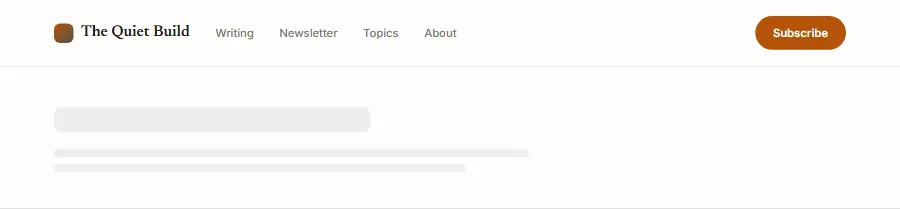
Copy step 2, paste it into your AI tool in the same chat, and you will get a result like the preview, in your own colours and content.
Show the prompt for step 2
Project recap: we are building The Quiet Build — A calm, reading-first personal blog and newsletter with a subscribe hero, featured essay, latest posts, topics, newsletter archive and author section. Stack: Next.js (App Router) + Tailwind CSS + Markdown. Keep using the design system, colours, fonts and components we already created; do not rewrite earlier sections.

Now build ONLY section 1 of 9: Navbar.

Requirements:
the site name as a text logo, links (Writing, Newsletter, Topics, About) and a "Subscribe" button.

Create it as components/Navbar.jsx (a Server Component unless it needs state or event handlers — then add "use client" and keep the interactive part as small as possible), and add it to app/page.js in position 1.

Rules:
- Use only the existing design tokens and UI components; add new tokens only if truly needed and tell me.
- Mobile-first and responsive at 375px, 768px and 1200px+.
- Accessible: semantic elements, correct heading level (only the hero uses h1), alt text, keyboard focus styles, labels on any form fields.
- Realistic sample content for The Quiet Build (no lorem ipsum).
- Show me the complete code for every file you create or change.
Intro hero
A short welcome ("Notes on building software and a calmer working life"), the number of readers ("Join 8,000+…
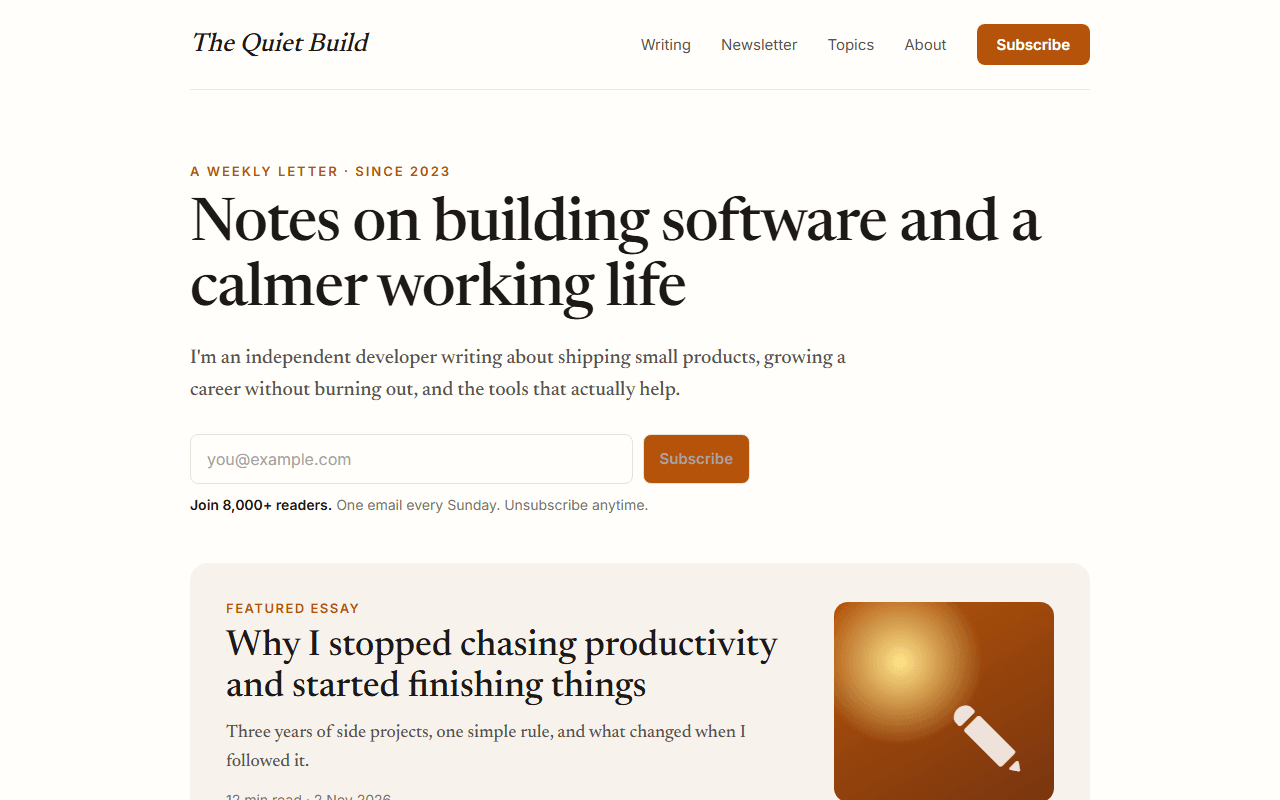
Copy step 3, paste it into your AI tool in the same chat, and you will get a result like the preview, in your own colours and content.
Show the prompt for step 3
Project recap: we are building The Quiet Build — A calm, reading-first personal blog and newsletter with a subscribe hero, featured essay, latest posts, topics, newsletter archive and author section. Stack: Next.js (App Router) + Tailwind CSS + Markdown. Keep using the design system, colours, fonts and components we already created; do not rewrite earlier sections. Now build ONLY section 2 of 9: Intro hero. Requirements: a short welcome ("Notes on building software and a calmer working life"), the number of readers ("Join 8,000+ readers"), an email field with a "Subscribe" button and "One email every Sunday. Unsubscribe anytime." Create it as components/IntroHero.jsx (a Server Component unless it needs state or event handlers — then add "use client" and keep the interactive part as small as possible), and add it to app/page.js in position 2. Rules: - Use only the existing design tokens and UI components; add new tokens only if truly needed and tell me. - Mobile-first and responsive at 375px, 768px and 1200px+. - Accessible: semantic elements, correct heading level (only the hero uses h1), alt text, keyboard focus styles, labels on any form fields. - Realistic sample content for The Quiet Build (no lorem ipsum). - Show me the complete code for every file you create or change.Featured essay
A large card with title, two-line excerpt, reading time, date and a "Read the essay" link.
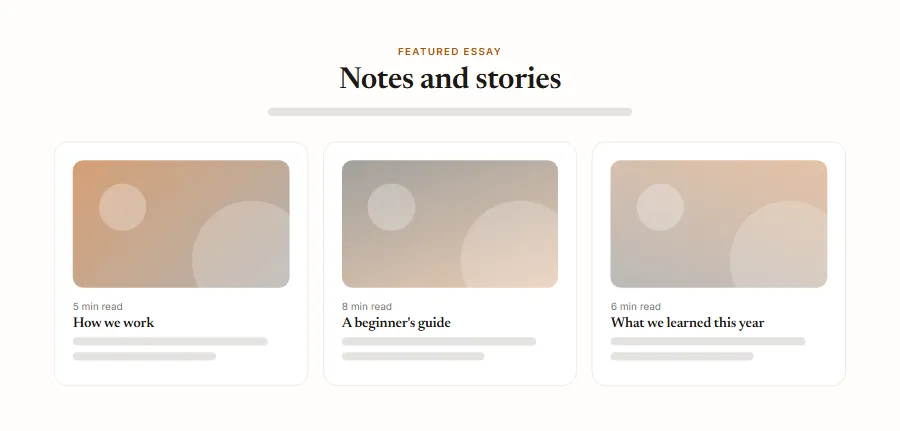
Copy step 4, paste it into your AI tool in the same chat, and you will get a result like the preview, in your own colours and content.
Show the prompt for step 4
Project recap: we are building The Quiet Build — A calm, reading-first personal blog and newsletter with a subscribe hero, featured essay, latest posts, topics, newsletter archive and author section. Stack: Next.js (App Router) + Tailwind CSS + Markdown. Keep using the design system, colours, fonts and components we already created; do not rewrite earlier sections.

Now build ONLY section 3 of 9: Featured essay.

Requirements:
a large card with title, two-line excerpt, reading time, date and a "Read the essay" link.

Create it as components/FeaturedEssay.jsx (a Server Component unless it needs state or event handlers — then add "use client" and keep the interactive part as small as possible), and add it to app/page.js in position 3.

Rules:
- Use only the existing design tokens and UI components; add new tokens only if truly needed and tell me.
- Mobile-first and responsive at 375px, 768px and 1200px+.
- Accessible: semantic elements, correct heading level (only the hero uses h1), alt text, keyboard focus styles, labels on any form fields.
- Realistic sample content for The Quiet Build (no lorem ipsum).
- Show me the complete code for every file you create or change.
Latest posts
A list of six posts with date, title, one-line summary and reading time.
Copy step 5, paste it into your AI tool in the same chat, and you will get a result like the preview, in your own colours and content.
Show the prompt for step 5
Project recap: we are building The Quiet Build — A calm, reading-first personal blog and newsletter with a subscribe hero, featured essay, latest posts, topics, newsletter archive and author section. Stack: Next.js (App Router) + Tailwind CSS + Markdown. Keep using the design system, colours, fonts and components we already created; do not rewrite earlier sections.

Now build ONLY section 4 of 9: Latest posts.

Requirements:
a list of six posts with date, title, one-line summary and reading time.

Create it as components/LatestPosts.jsx (a Server Component unless it needs state or event handlers — then add "use client" and keep the interactive part as small as possible), and add it to app/page.js in position 4.

Rules:
- Use only the existing design tokens and UI components; add new tokens only if truly needed and tell me.
- Mobile-first and responsive at 375px, 768px and 1200px+.
- Accessible: semantic elements, correct heading level (only the hero uses h1), alt text, keyboard focus styles, labels on any form fields.
- Realistic sample content for The Quiet Build (no lorem ipsum).
- Show me the complete code for every file you create or change.
Topics
Tags with post counts (Product, Career, Productivity, Engineering, Writing, Tools).
Copy step 6, paste it into your AI tool in the same chat, and you will get a result like the preview, in your own colours and content.
Show the prompt for step 6
Project recap: we are building The Quiet Build — A calm, reading-first personal blog and newsletter with a subscribe hero, featured essay, latest posts, topics, newsletter archive and author section. Stack: Next.js (App Router) + Tailwind CSS + Markdown. Keep using the design system, colours, fonts and components we already created; do not rewrite earlier sections.

Now build ONLY section 5 of 9: Topics.

Requirements:
tags with post counts (Product, Career, Productivity, Engineering, Writing, Tools).

Create it as components/Topics.jsx (a Server Component unless it needs state or event handlers — then add "use client" and keep the interactive part as small as possible), and add it to app/page.js in position 5.

Rules:
- Use only the existing design tokens and UI components; add new tokens only if truly needed and tell me.
- Mobile-first and responsive at 375px, 768px and 1200px+.
- Accessible: semantic elements, correct heading level (only the hero uses h1), alt text, keyboard focus styles, labels on any form fields.
- Realistic sample content for The Quiet Build (no lorem ipsum).
- Show me the complete code for every file you create or change.
Newsletter archive
The last five issues with issue number, title and date.
Copy step 7, paste it into your AI tool in the same chat, and you will get a result like the preview, in your own colours and content.
Show the prompt for step 7
Project recap: we are building The Quiet Build — A calm, reading-first personal blog and newsletter with a subscribe hero, featured essay, latest posts, topics, newsletter archive and author section. Stack: Next.js (App Router) + Tailwind CSS + Markdown. Keep using the design system, colours, fonts and components we already created; do not rewrite earlier sections.

Now build ONLY section 6 of 9: Newsletter archive.

Requirements:
the last five issues with issue number, title and date.

Create it as components/NewsletterArchive.jsx (a Server Component unless it needs state or event handlers — then add "use client" and keep the interactive part as small as possible), and add it to app/page.js in position 6.

Rules:
- Use only the existing design tokens and UI components; add new tokens only if truly needed and tell me.
- Mobile-first and responsive at 375px, 768px and 1200px+.
- Accessible: semantic elements, correct heading level (only the hero uses h1), alt text, keyboard focus styles, labels on any form fields.
- Realistic sample content for The Quiet Build (no lorem ipsum).
- Show me the complete code for every file you create or change.
About the author
Photo, a short bio, what the newsletter covers and links to social profiles.
Copy step 8, paste it into your AI tool in the same chat, and you will get a result like the preview, in your own colours and content.
Show the prompt for step 8
Project recap: we are building The Quiet Build — A calm, reading-first personal blog and newsletter with a subscribe hero, featured essay, latest posts, topics, newsletter archive and author section. Stack: Next.js (App Router) + Tailwind CSS + Markdown. Keep using the design system, colours, fonts and components we already created; do not rewrite earlier sections.

Now build ONLY section 7 of 9: About the author.

Requirements:
photo, a short bio, what the newsletter covers and links to social profiles.

Create it as components/AboutTheAuthor.jsx (a Server Component unless it needs state or event handlers — then add "use client" and keep the interactive part as small as possible), and add it to app/page.js in position 7.

Rules:
- Use only the existing design tokens and UI components; add new tokens only if truly needed and tell me.
- Mobile-first and responsive at 375px, 768px and 1200px+.
- Accessible: semantic elements, correct heading level (only the hero uses h1), alt text, keyboard focus styles, labels on any form fields.
- Realistic sample content for The Quiet Build (no lorem ipsum).
- Show me the complete code for every file you create or change.
Reader notes
Three short quotes from readers.
Copy step 9, paste it into your AI tool in the same chat, and you will get a result like the preview, in your own colours and content.
Show the prompt for step 9
Project recap: we are building The Quiet Build — A calm, reading-first personal blog and newsletter with a subscribe hero, featured essay, latest posts, topics, newsletter archive and author section. Stack: Next.js (App Router) + Tailwind CSS + Markdown. Keep using the design system, colours, fonts and components we already created; do not rewrite earlier sections.

Now build ONLY section 8 of 9: Reader notes.

Requirements:
three short quotes from readers.

Create it as components/ReaderNotes.jsx (a Server Component unless it needs state or event handlers — then add "use client" and keep the interactive part as small as possible), and add it to app/page.js in position 8.

Rules:
- Use only the existing design tokens and UI components; add new tokens only if truly needed and tell me.
- Mobile-first and responsive at 375px, 768px and 1200px+.
- Accessible: semantic elements, correct heading level (only the hero uses h1), alt text, keyboard focus styles, labels on any form fields.
- Realistic sample content for The Quiet Build (no lorem ipsum).
- Show me the complete code for every file you create or change.
Footer
RSS link, email, social links and copyright.
Copy step 10, paste it into your AI tool in the same chat, and you will get a result like the preview, in your own colours and content.
Show the prompt for step 10
Project recap: we are building The Quiet Build — A calm, reading-first personal blog and newsletter with a subscribe hero, featured essay, latest posts, topics, newsletter archive and author section. Stack: Next.js (App Router) + Tailwind CSS + Markdown. Keep using the design system, colours, fonts and components we already created; do not rewrite earlier sections.

Now build ONLY section 9 of 9: Footer.

Requirements:
RSS link, email, social links and copyright.

Create it as components/Footer.jsx (a Server Component unless it needs state or event handlers — then add "use client" and keep the interactive part as small as possible), and add it to app/page.js in position 9.

Rules:
- Use only the existing design tokens and UI components; add new tokens only if truly needed and tell me.
- Mobile-first and responsive at 375px, 768px and 1200px+.
- Accessible: semantic elements, correct heading level (only the hero uses h1), alt text, keyboard focus styles, labels on any form fields.
- Realistic sample content for The Quiet Build (no lorem ipsum).
- Show me the complete code for every file you create or change.
Interactions and animation
Hover states, scroll reveals and any interactive behaviour, without hurting performance.
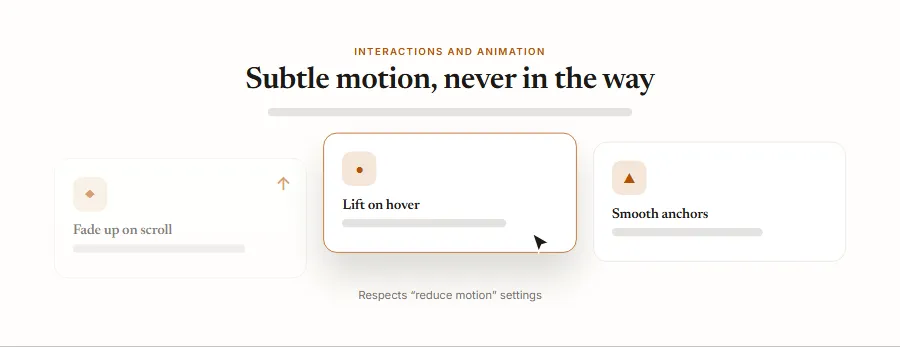
Copy step 11, paste it into your AI tool in the same chat, and you will get a result like the preview, in your own colours and content.
Show the prompt for step 11
Project recap: we are building The Quiet Build — A calm, reading-first personal blog and newsletter with a subscribe hero, featured essay, latest posts, topics, newsletter archive and author section. Stack: Next.js (App Router) + Tailwind CSS + Markdown. Keep using the design system, colours, fonts and components we already created; do not rewrite earlier sections.

All sections are built. Now add the interactions and animation layer.

Required behaviour:
the subscribe form validates the email and shows a success message; links have a subtle underline animation; the page supports a dark theme following the system setting.

Also:
- Subtle hover and focus states on every link, button and card.
- Elements fade and slide up slightly as they scroll into view (IntersectionObserver in one small client component); run each animation once.
- Smooth scrolling for in-page links, with an offset for the sticky header.
- Every animation must be disabled when the user has prefers-reduced-motion set.
- Do not add heavy animation libraries. Show the full code of each changed file.
More pages3 steps
Article page
A new /writing/[slug] page that matches the rest of the site.
Copy step 12, paste it into your AI tool in the same chat, and you will get a result like the preview, in your own colours and content.
Show the prompt for step 12
Project recap: we are building The Quiet Build — A calm, reading-first personal blog and newsletter with a subscribe hero, featured essay, latest posts, topics, newsletter archive and author section. Stack: Next.js (App Router) + Tailwind CSS + Markdown. Keep using the design system, colours, fonts and components we already created; do not rewrite earlier sections.

The home page is finished. Now add an article page rendered from Markdown with title, date, reading time, table of contents, a subscribe box at the end and previous/next links.

Route: /writing/[slug].
- Move the Navbar and Footer into app/layout.js (if not already there) so every page shares them, and add a link to this page in the navigation.
- Put shared mock data in a lib/ or data/ file, not inside the component.
- Give the page its own metadata (title and description).
- Same design system and components, responsive and accessible as before.
- Show the full code for every new or changed file.
Writing archive
A new /writing page that matches the rest of the site.
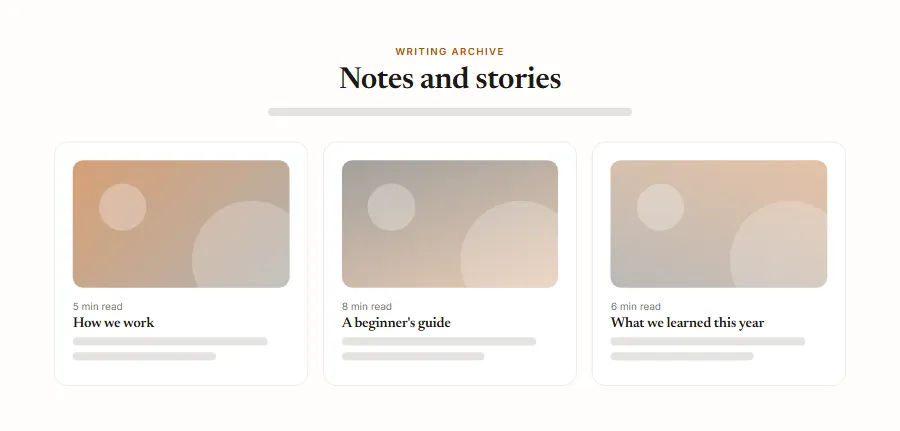
Copy step 13, paste it into your AI tool in the same chat, and you will get a result like the preview, in your own colours and content.
Show the prompt for step 13
Project recap: we are building The Quiet Build — A calm, reading-first personal blog and newsletter with a subscribe hero, featured essay, latest posts, topics, newsletter archive and author section. Stack: Next.js (App Router) + Tailwind CSS + Markdown. Keep using the design system, colours, fonts and components we already created; do not rewrite earlier sections.

The home page is finished. Now add all posts grouped by year with a topic filter and search.

Route: /writing.
- Move the Navbar and Footer into app/layout.js (if not already there) so every page shares them, and add a link to this page in the navigation.
- Put shared mock data in a lib/ or data/ file, not inside the component.
- Give the page its own metadata (title and description).
- Same design system and components, responsive and accessible as before.
- Show the full code for every new or changed file.
About page
A new /about page that matches the rest of the site.
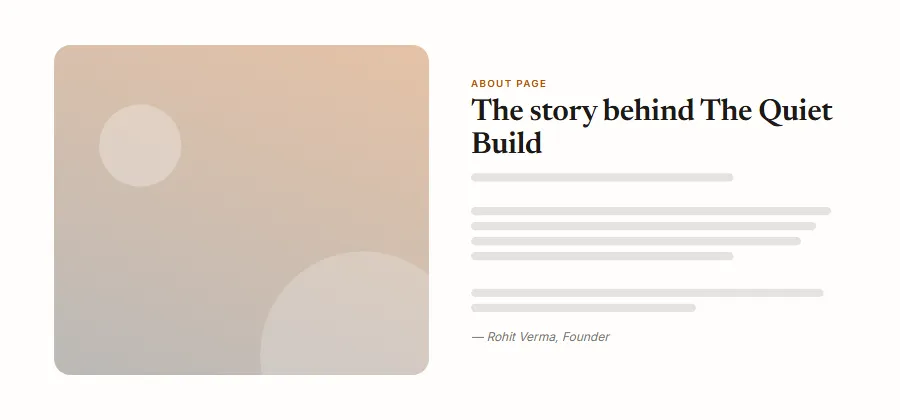
Copy step 14, paste it into your AI tool in the same chat, and you will get a result like the preview, in your own colours and content.
Show the prompt for step 14
Project recap: we are building The Quiet Build — A calm, reading-first personal blog and newsletter with a subscribe hero, featured essay, latest posts, topics, newsletter archive and author section. Stack: Next.js (App Router) + Tailwind CSS + Markdown. Keep using the design system, colours, fonts and components we already created; do not rewrite earlier sections.

The home page is finished. Now add a longer author story, what readers can expect from the newsletter, and contact details.

Route: /about.
- Move the Navbar and Footer into app/layout.js (if not already there) so every page shares them, and add a link to this page in the navigation.
- Put shared mock data in a lib/ or data/ file, not inside the component.
- Give the page its own metadata (title and description).
- Same design system and components, responsive and accessible as before.
- Show the full code for every new or changed file.
Polish and launch3 steps
Responsive and accessibility review
A page that works on every screen size and with a keyboard or screen reader.
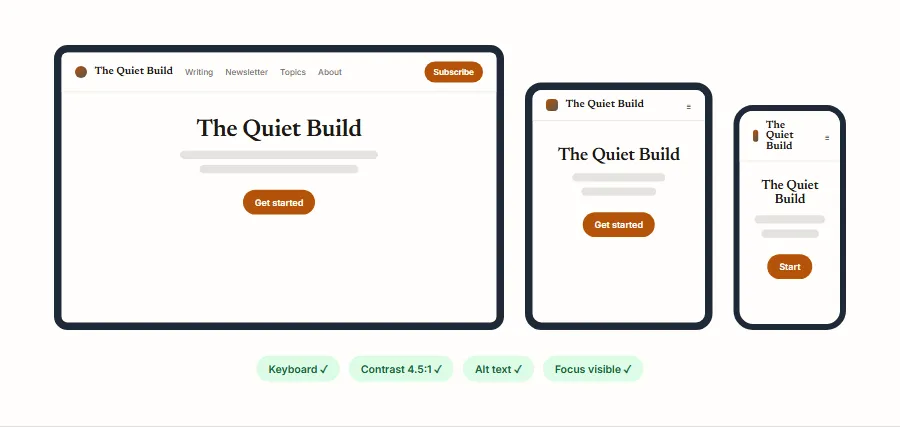
Copy step 15, paste it into your AI tool in the same chat, and you will get a result like the preview, in your own colours and content.
Show the prompt for step 15
Project recap: we are building The Quiet Build — A calm, reading-first personal blog and newsletter with a subscribe hero, featured essay, latest posts, topics, newsletter archive and author section. Stack: Next.js (App Router) + Tailwind CSS + Markdown. Keep using the design system, colours, fonts and components we already created; do not rewrite earlier sections.

Review the whole site and fix problems. Go through it at 360px, 768px, 1024px and 1440px widths and check:
- No horizontal scrolling, nothing overlapping, text never cut off, tap targets at least 44px.
- One h1 per page and a logical heading order; landmarks (header, nav, main, footer).
- Every image has meaningful alt text (or empty alt if decorative); every form field has a label and error messages are announced.
- Everything works with the keyboard alone, focus is always visible, and menus/accordions/modals manage focus and close with Escape.
- Colour contrast of at least 4.5:1 for body text.
List each issue you found and the fix, then show the changed code.
SEO and performance
Search-friendly metadata, social previews and fast loading.
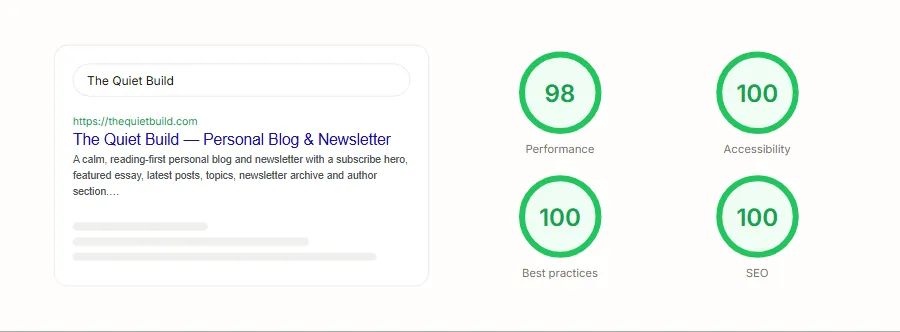
Copy step 16, paste it into your AI tool in the same chat, and you will get a result like the preview, in your own colours and content.
Show the prompt for step 16
Project recap: we are building The Quiet Build — A calm, reading-first personal blog and newsletter with a subscribe hero, featured essay, latest posts, topics, newsletter archive and author section. Stack: Next.js (App Router) + Tailwind CSS + Markdown. Keep using the design system, colours, fonts and components we already created; do not rewrite earlier sections.

Prepare the site for search engines and fast loading:
- Metadata for every page (title, description, canonical, Open Graph and Twitter card) using the Metadata API, and a title template.
- app/sitemap.js and app/robots.js.
- JSON-LD structured data that fits The Quiet Build (Organization or LocalBusiness, plus FAQPage if there is an FAQ).
- Use next/image with correct sizes for every image, preload only the hero image, and lazy-load the rest.
- Make sure no component is a Client Component unless it needs to be.
Then tell me how to check the result with Lighthouse and what score to aim for.
Launch
The website live on the internet with your own domain.
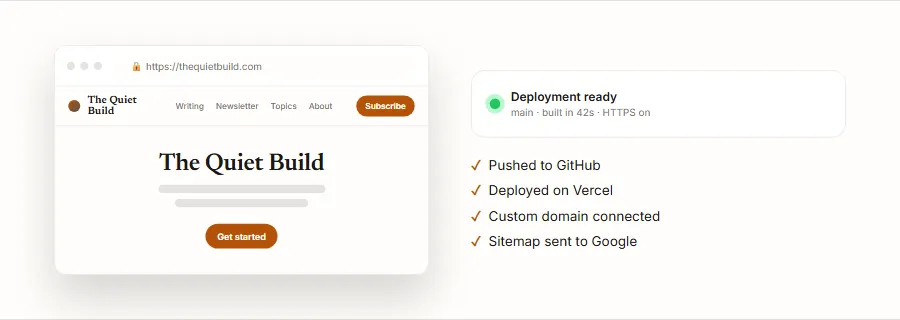
Copy step 17, paste it into your AI tool in the same chat, and you will get a result like the preview, in your own colours and content.
Show the prompt for step 17
Project recap: we are building The Quiet Build — A calm, reading-first personal blog and newsletter with a subscribe hero, featured essay, latest posts, topics, newsletter archive and author section. Stack: Next.js (App Router) + Tailwind CSS + Markdown. Keep using the design system, colours, fonts and components we already created; do not rewrite earlier sections.

The site is ready. Walk me through launching it, step by step, for a beginner:
1. Push the project to a new GitHub repository (exact git commands).
2. Deploy it on Vercel (free plan) from that repository.
3. Connect a custom domain and set up HTTPS.
4. Add any environment variables the project needs.
5. Submit the sitemap to Google Search Console.
6. A final pre-launch checklist: replace all sample text, images, prices and contact details with real ones, test every link and form, and check it on a real phone.
Or: the one-shot prompt
Prefer to generate the home page in one go? Copy everything in the box. It works best in tools that can write many files at once (Cursor, Claude Code, v0, Bolt). Text in quotes and the sample business details are meant to be replaced with your own.
Build a complete personal blog and newsletter website called "The Quiet Build", written by an independent software developer about building products, careers and calm productivity.

Tech stack: Next.js (App Router) with Tailwind CSS. Posts are Markdown files in a content/ folder, read at build time. Server Components everywhere except the subscribe form.

Visual style: reading-first, warm and minimal. Paper white background (#fffefb), ink text (#1c1917), burnt amber (#b45309) for links and the subscribe button, and stone grey (#57534e) for dates and meta. A readable serif for headings and articles (such as Newsreader) with a small sans-serif for the interface. Line length around 65 characters, generous line height, no sidebars.

Sections, in order:
1. Navbar: the site name as a text logo, links (Writing, Newsletter, Topics, About) and a "Subscribe" button.
2. Intro hero: a short welcome ("Notes on building software and a calmer working life"), the number of readers ("Join 8,000+ readers"), an email field with a "Subscribe" button and "One email every Sunday. Unsubscribe anytime."
3. Featured essay: a large card with title, two-line excerpt, reading time, date and a "Read the essay" link.
4. Latest posts: a list of six posts with date, title, one-line summary and reading time.
5. Topics: tags with post counts (Product, Career, Productivity, Engineering, Writing, Tools).
6. Newsletter archive: the last five issues with issue number, title and date.
7. About the author: photo, a short bio, what the newsletter covers and links to social profiles.
8. Reader notes: three short quotes from readers.
9. Footer: RSS link, email, social links and copyright.

Interactions: the subscribe form validates the email and shows a success message; links have a subtle underline animation; the page supports a dark theme following the system setting.

Quality bar:
- Fully responsive: design mobile-first, then tablet (768px) and desktop (1200px).
- Accessible: semantic HTML landmarks, one h1, alt text on images, visible keyboard focus, colour contrast of at least 4.5:1 for body text.
- Fast: no heavy libraries, lazy-load images below the fold, system or two web fonts at most.
- Use placeholder images from a neutral source and realistic sample copy (no lorem ipsum).
- Respect prefers-reduced-motion for every animation.
- Keep the code clean and commented so I can edit it by hand.
How to use these prompts
- 1
Open an AI coding tool. Use any capable assistant: Claude, ChatGPT, Cursor, v0, Bolt, Gemini. Tools that can create files (Cursor, Claude Code, v0, Bolt) are the most convenient because they write the project for you.
- 2
Replace the sample details. Copy the prompt and change the business name, location, colours and any section you do not need. The more specific your details, the better the result.
- 3
Paste the prompts one by one. Start with step 1 of the step-by-step build and send each next step only when the previous one works. If a reply is cut off, say “continue from where you stopped”. Or send the one-shot prompt if you want the whole home page at once.
- 4
Run it on your computer. Create a project with “npx create-next-app@latest”, add the generated files, then run “npm run dev” and open http://localhost:3000.
- 5
Review and refine. Check it on a phone-width screen, fix anything that looks off by describing it in plain words, then use the follow-up prompts below to add features one at a time.
- 6
Replace placeholders and publish. Swap in your real text and images, then deploy. Vercel and Netlify both host this kind of site for free.
Follow-up prompts
Send these one at a time after the first version is working. Small, specific requests give much better results than one giant prompt.
Build the /writing/[slug] article page with a table of contents, reading progress bar, code highlighting and previous/next links.
Generate an RSS feed at /feed.xml from the Markdown posts.
Connect the subscribe form to a Server Action that stores emails, with validation and duplicate checks.
Add BlogPosting JSON-LD and dynamic Open Graph images for each article.
Tips for a better result
- Write five posts before launching so the site never looks empty.
- Keep the subscribe form both at the top and at the end of every article.
- Want to hand-build a section instead? The Templates library has heroes, pricing tables, FAQs and more with full code.